
Most facilities have arc flash labels but still get PPE wrong. Either the label is incomplete, outdated, or the team doesn't understand what it's telling them. NFPA 70E lays out the requirements. Here's what the standard actually says and where most facilities fall short.
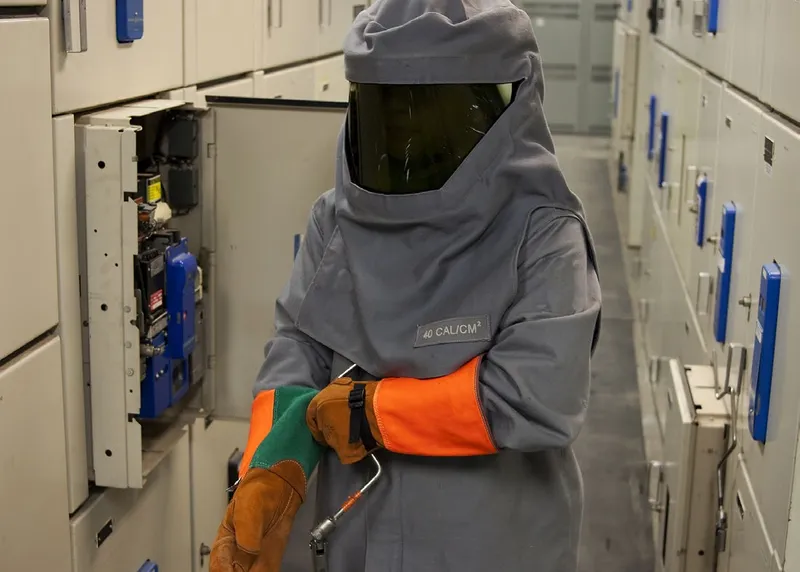
Why PPE Requirements Exist
An arc flash can release temperatures exceeding 35,000 degrees F in a fraction of a second. Standard work clothing, whether cotton, polyester, or blended fabrics, will ignite or melt at those temperatures, causing severe burns or death. Arc-rated PPE is specifically designed to resist ignition and limit heat transfer below the second-degree burn threshold (about 1.2 cal/cm²).
NFPA 70E and OSHA both require employers to protect workers from arc flash hazards. The PPE you're required to wear is determined by the incident energy at the equipment you're working on, which is exactly what an arc flash study calculates using IEEE 1584-2018 methodology.
The Two Methods for Determining PPE
NFPA 70E gives you two ways to determine what PPE is required:
1. The Incident Energy Analysis Method (NFPA 70E 130.5(G))
This is the more precise approach and what a PE-stamped arc flash study produces. The study calculates the incident energy at each piece of equipment in cal/cm², a measurement of the thermal energy that could reach a worker at a defined working distance, typically 18 inches for low voltage equipment. If that distance changes, the exposure changes. Your PPE must be rated at or above that incident energy level.
Incident energy is also driven more by clearing time than fault current. Slower protective device operation, a breaker that takes longer to open, can increase exposure significantly, even at lower fault currents. That's why equipment maintenance and protection coordination matter as much as the study itself.
The required ensemble changes based on exposure level. There are two tiers per Table 130.5(G):
Incident Energy Analysis Method: PPE Requirements (Per NFPA 70E Table 130.5(G))
| Exposure Level | Arc-Rated Clothing | Head/Face | Gloves |
|---|---|---|---|
| 1.2–12 cal/cm² | Arc-rated shirt & pants, coverall, or arc flash suit, rated at or above incident energy | Arc-rated face shield + balaclava OR arc flash suit hood | Heavy leather, arc-rated, or rubber insulating with protectors |
| Above 12 cal/cm² | Arc-rated shirt & pants, coverall, or arc flash suit, rated at or above incident energy | Arc flash suit hood required. Face shield + balaclava is no longer acceptable. | Arc-rated or rubber insulating with protectors |
All exposures require: hard hat, safety glasses or goggles, hearing protection, leather footwear.
The 12 cal/cm² threshold is a hard line per Table 130.5(G). A face shield with balaclava is acceptable below it, not above it. A facility assuming low exposure and using only a face shield on higher-energy equipment isn't just underprotected, it's out of compliance.
The arc flash boundary is the distance at which incident energy drops to 1.2 cal/cm², the threshold for a second-degree burn. Anyone inside that boundary requires arc-rated PPE. Anyone outside it doesn't need arc-rated gear, but still must stay clear of shock approach boundaries.
2. The Arc Flash PPE Category Method (NFPA 70E 130.7(C)(15))
This is a table-based shortcut built into NFPA 70E. Based on the type of equipment and system voltage, you look up the corresponding PPE category (1, 2, 3, or 4) and wear the gear specified for that category. It's faster but more conservative, and it only applies when the equipment meets specific fault current and clearing time parameters outlined in the standard.
Many facilities default to the PPE category method because it doesn't require a full arc flash study. But if you're relying on tables instead of a calculated study, there's a good chance you're either overprotecting (heavier, hotter gear that workers resist wearing consistently) or underprotecting, which is actual risk. The category method also can't be applied to all equipment types, and it can't be mixed with incident energy analysis on the same piece of equipment.
Note: NFPA 70E requires that only one method be used per piece of equipment. You cannot use both methods on the same equipment, and an incident energy analysis cannot be used to assign a PPE category.
The PPE Categories — AC Systems
Per NFPA 70E Table 130.7(C)(15)(a):
Arc Flash PPE Categories: AC Equipment
| Category | Min Arc Rating | Typical Equipment |
|---|---|---|
| 1 | 4 cal/cm² | ≤240V panelboards |
| 2 | 8 cal/cm² | >240V–600V panels; 600V MCCs (fast clearing, ≤2 cycles); other 600V equipment |
| 4 | 40 cal/cm² | 600V MCCs (slow clearing, 20 cycles); 600V switchgear/switchboards; MV 1kV–15kV |
Note: Category 3 does not appear in the AC equipment table. It is still defined in NFPA 70E Table 130.7(C)(15)(c) and is commonly encountered when using incident energy analysis or DC systems. PPE categories apply only when equipment meets the fault current and clearing time limits in NFPA 70E Table 130.7(C)(15)(a). Outside those parameters, an incident energy analysis is required.
The PPE Categories — DC Systems
Per NFPA 70E Table 130.7(C)(15)(b), DC systems (storage batteries, DC switchboards, and other DC supply sources, above 150V–600V) are categorized by available fault current:
Arc Flash PPE Categories: DC Systems
| Category | Min Arc Rating | Fault Current | Arc Flash Boundary |
|---|---|---|---|
| 2 | 8 cal/cm² | Less than 3 kA | Up to 1.2 m (4 ft) |
| 3 | 25 cal/cm² | 3 kA to less than 7 kA | 1.8 m (6 ft) |
| 4 | 40 cal/cm² | 7 kA to less than 10 kA | 2.5 m (8 ft) |
Two important notes on DC: First, the table assumes a 2-second arc duration where no overcurrent protective device exists or fault clearing time is unknown. Battery systems often fall into this situation, which is why DC categories can be higher than expected at relatively modest fault currents. Second, this table only covers systems above 150V DC. Systems below that voltage are not covered by this table and require an incident energy analysis.
PPE Requirements by Category
Once you've identified the category from the AC or DC tables above, Table 130.7(C)(15)(c) tells you exactly what to wear:
PPE Requirements by Arc Flash Category (Per NFPA 70E Table 130.7(C)(15)(c))
| Category | Min Arc Rating | Clothing | Head/Face | Gloves | Footwear |
|---|---|---|---|---|---|
| 1 | 4 cal/cm² | Arc-rated shirt & pants or coverall | Arc-rated face shield or arc flash suit hood | Heavy leather, arc-rated, or rubber insulating with protectors | Leather (AN) |
| 2 | 8 cal/cm² | Arc-rated shirt & pants or coverall | Arc-rated face shield + balaclava OR arc flash suit hood | Heavy leather, arc-rated, or rubber insulating with protectors | Leather required |
| 3 | 25 cal/cm² | Arc-rated shirt, pants, coverall, arc flash suit jacket & pants | Arc flash suit hood required | Arc-rated or rubber insulating with protectors | Leather required |
| 4 | 40 cal/cm² | Arc-rated shirt, pants, coverall, arc flash suit jacket & pants | Arc flash suit hood required | Arc-rated or rubber insulating with protectors | Leather required |
All categories require: hard hat, safety glasses or goggles, hearing protection.
AN: As needed (optional)
How This Works in Practice
We don't just run a study and hand over numbers. Before finalizing arc flash labels, we discuss PPE inventory directly with the client. If a facility already has arc-rated gear rated to a specific level, we align the study deliverables with what they have on hand, so they're not forced into unnecessary equipment purchases where existing PPE is adequate. For facilities starting from scratch, we default to labeling based on the full calculated incident energy up to the 40 cal/cm² Category 4 threshold, giving them a clear baseline for procurement.
This conversation is part of every study. The labels should reflect reality, not just what's theoretically required on paper.
The Label Tells You What You Need
A properly completed arc flash label does the work for you. Per NFPA 70E 130.5(H) and 2026 NEC Section 110.16, labels must include:
- Nominal system voltage
- Arc flash boundary
- Available incident energy and working distance, or minimum arc rating of PPE, or arc flash PPE category
If your labels only say "WARNING: ARC FLASH HAZARD" without incident energy values or PPE category information, your workers don't have what they need to select the right PPE.
Common Mistakes
Wearing the wrong arc rating. An arc-rated shirt rated at 4 cal/cm² doesn't protect you at a panel with 12 cal/cm² of incident energy. The rating on your gear must meet or exceed the incident energy on the label.
Mixing non-rated and rated gear. A single non-rated piece of clothing in an otherwise compliant ensemble creates a weak point. Everything within the arc flash boundary must be arc-rated.
Using a face shield above 12 cal/cm². Per Table 130.5(G), this is a hard requirement. A face shield with balaclava is not an acceptable substitute above 12 cal/cm². An arc flash suit hood is required.
Using PPE categories where they don't apply. The category method has specific fault current and clearing time parameters. Outside those parameters it's not compliant. An incident energy analysis is required.
Outdated labels. If the incident energy is wrong, the PPE selection is wrong. That's where most facilities are actually exposed, not from a lack of PPE, but from relying on outdated or incorrect data. Changes like utility upgrades, transformer replacements, or protective device setting changes can invalidate existing labels.
The Bottom Line
PPE is your last line of defense. The arc flash study determines the hazard level. The label communicates it. The PPE protects against it. All three have to be current and accurate for the system to work.
If your labels don't include incident energy values or haven't been updated since your last electrical changes, your PPE selection is based on bad data. That's where problems start.
We fix that.
Our studies are PE-stamped, IEEE 1584-2018 compliant, and produce labels that meet 2026 NEC Section 110.16 requirements across Minnesota, Illinois, Wisconsin, and Colorado.
Need an Arc Flash Study?
Send over your one-line diagram or a brief system description. We will review it and provide a clear project schedule, fixed fee, and defined scope with no surprises.