
What Is an Arc Flash Study?
An arc flash study is a systematic engineering analysis that calculates the potential incident energy at every point in your electrical distribution system where workers may interact with energized equipment. The study determines the thermal hazard level, measured in calories per square centimeter (cal/cm²), and defines the arc flash boundary, working distances, and required personal protective equipment (PPE) for each piece of equipment.
The analysis follows IEEE 1584, Guide for Performing Arc-Flash Hazard Calculations, which is the industry-accepted standard methodology. Results are used to produce arc flash warning labels that OSHA and NFPA 70E require to be posted on electrical equipment.
Without a current arc flash study, your facility is exposed to significant regulatory, legal, and safety risks. An arc flash incident can produce temperatures exceeding 35,000°F, hotter than the surface of the sun, with blast pressures that can throw a worker across a room. Proper hazard analysis and labeling are the first line of defense.
Why Your Facility Needs an Arc Flash Study
Arc flash studies are not optional for most commercial and industrial facilities. Both OSHA regulations and NFPA 70E (Standard for Electrical Safety in the Workplace) require employers to assess electrical hazards and protect workers accordingly. Here's why this matters:
- OSHA Compliance: OSHA 29 CFR 1910.132(d) requires employers to perform a hazard assessment and select appropriate PPE. OSHA uses NFPA 70E as the benchmark for electrical safety. Facilities without a current arc flash study face citations, fines, and increased scrutiny during inspections.
- NFPA 70E Requirements: NFPA 70E, Article 130, mandates that arc flash hazard analysis be performed to determine the arc flash boundary and PPE requirements. The standard also requires that equipment be labeled with arc flash information.
- Insurance & Liability: Many insurance carriers now require arc flash studies as a condition of coverage or to qualify for favorable premiums. In the event of an incident, the absence of a study can create serious liability exposure.
- Worker Safety: The most important reason is protecting the people who work on and around your electrical equipment. Accurate incident energy data means workers wear the right PPE, not too little (dangerous) and not too much (which creates heat stress and reduces dexterity).
- Equipment Modifications: Any time you add or modify electrical equipment, such as new switchgear, transformer upgrades, or utility feed changes, your existing arc flash study may be invalidated. IEEE 1584 and NFPA 70E both recommend updating the study every five years, or whenever significant changes are made.
How We Perform an Arc Flash Study
Zech Engineering follows a thorough, proven process for every arc flash study. Our methodology is grounded in IEEE 1584-2018 and tailored to the specific needs of your facility.
1. Data Collection & Field Survey
Every study begins with a comprehensive field survey of your electrical distribution system. We collect nameplate data from transformers, switchgear, panelboards, motor control centers, and protective devices. This includes breaker types, trip settings, fuse ratings, conductor sizes, and system configuration details.
If existing one-line diagrams are available, we use them as a starting point and verify accuracy in the field. If one-line drawings don't exist or are outdated, we develop them as part of the study scope.
2. System Modeling
Using the field-collected data, we build a detailed computer model of your electrical distribution system. The model includes all significant impedance sources, including utility contribution, transformers, cables, buses, and protective devices, from the service entrance through the last point of worker interaction.
We use industry-standard power systems analysis software (SKM Power*Tools) to model the system and perform calculations.
3. Short-Circuit Analysis
Before calculating arc flash incident energy, we perform a short-circuit analysis to determine the available fault current at each bus in the system. This is a foundational step, as arc flash energy is directly related to the magnitude and duration of the arcing current.
We calculate both maximum and minimum fault current scenarios, as arc flash hazard can sometimes be worse at reduced fault current levels due to longer clearing times from protective devices.
4. Protective Device Coordination Review
We evaluate the time-current characteristics of every protective device in the system, including circuit breakers, fuses, and relays, to determine the actual clearing time for an arcing fault at each location. This step is critical because the duration of the arc is one of the primary drivers of incident energy.
If we identify coordination issues that significantly increase arc flash hazard levels, we'll flag them and recommend protective device setting changes or equipment upgrades that can reduce incident energy.
5. Arc Flash Calculations
With fault current magnitudes and clearing times established, we calculate the incident energy at each bus using the IEEE 1584-2018 methodology. For each location, we determine:
- Incident energy at the working distance (cal/cm²)
- Arc flash boundary — the distance at which incident energy drops to 1.2 cal/cm²
- PPE category per NFPA 70E Table 130.7(C)(15)(c)
- Shock hazard boundaries (limited and restricted approach)
6. Equipment Labels
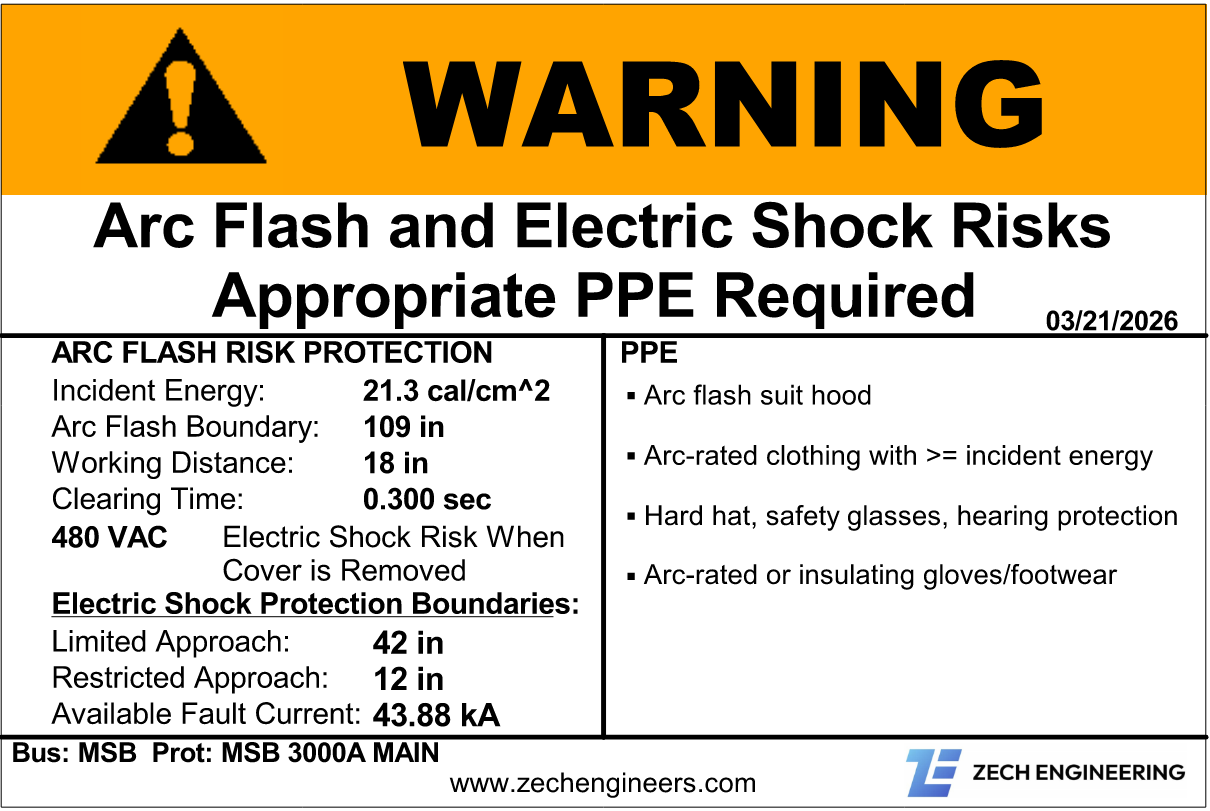
For every piece of equipment included in the study, we produce a custom arc flash warning label that complies with NFPA 70E Section 130.5(H). Each label includes:
- Incident energy at the working distance
- Arc flash boundary
- Required PPE category and specific PPE items
- Shock hazard approach boundaries
- Equipment identification
- Date of study and nominal system voltage
Labels are printed on durable, adhesive-backed material designed for industrial environments and shipped directly to your facility, ready for installation.
 SAMPLE
 7. Engineering Report
The final deliverable is a comprehensive engineering report, PE-stamped and sealed, containing:
- Updated one-line diagrams
- Complete short-circuit analysis results
- Arc flash incident energy calculations for every bus
- Protective device coordination time-current curves
- PPE requirements summary table
- Mitigation recommendations for reducing incident energy levels
- Arc flash warning labels
Arc Flash Mitigation Strategies
Beyond calculating and labeling hazard levels, Zech Engineering provides actionable mitigation recommendations to reduce incident energy wherever practical. Common strategies include:
- Protective device setting optimization: Adjusting breaker trip settings and adding instantaneous overrides to reduce arc duration
- Zone-selective interlocking (ZSI): Implementing communication between protective devices to accelerate clearing times
- Bus differential protection: Adding relay schemes that detect and clear faults within one or two cycles
- Current-limiting fuses: Replacing standard fuses with current-limiting types that significantly reduce let-through energy
- Arc flash relay systems: Light-sensing relays that detect an arc and trip the upstream breaker in milliseconds
- Remote racking and operation: Engineering controls that remove the worker from the arc flash boundary during switching operations
- Maintenance mode settings: Temporary protective device settings that reduce incident energy during maintenance activities
When to Update Your Arc Flash Study
Both NFPA 70E and industry best practice recommend updating your arc flash study:
- At least every five years
- Whenever significant modifications are made to the electrical system
- When utility fault current contribution changes (utility upgrades, new substations)
- After adding or removing major loads or generation sources
- When protective device settings are changed
- After any arc flash incident
If your last study is more than five years old, or if your system has been modified since the study was performed, contact us to discuss an update. With the 2026 NEC rewriting Section 110.16, detailed labeling is now inspector-enforceable, making study currency more visible than ever.
Industries We Serve
Zech Engineering provides arc flash studies for a wide range of facility types, including:
- Manufacturing plants and production facilities
- Distribution and warehouse operations
- Commercial office buildings and retail complexes
- Hospitals and skilled nursing facilities
- Data centers and telecommunications facilities
- Municipal and government buildings
- Educational institutions
Why Choose Zech Engineering for Your Arc Flash Study?
When you work with Zech Engineering, you work directly with Nick Zech, PE, a licensed Professional Engineer with specialized expertise in arc flash hazard analysis and power systems. You get senior-level expertise and direct access to your engineer on every project.
- PE licensed in multiple states. Registered in IL, MN, CA, CO, and WI.
- IEEE member with deep knowledge of IEEE 1584 methodology.
- We focus exclusively on arc flash studies and power systems analysis. This is not a sideline service.
- Clear communication. Technical findings explained in plain language with actionable recommendations.
- Complete deliverables. PE-stamped reports, custom labels, updated one-lines, and mitigation strategies.
Get Started With Your Arc Flash Study
Contact Zech Engineering for a free consultation and proposal. We'll discuss your facility, scope the project, and provide a clear timeline and fixed-fee quote.