
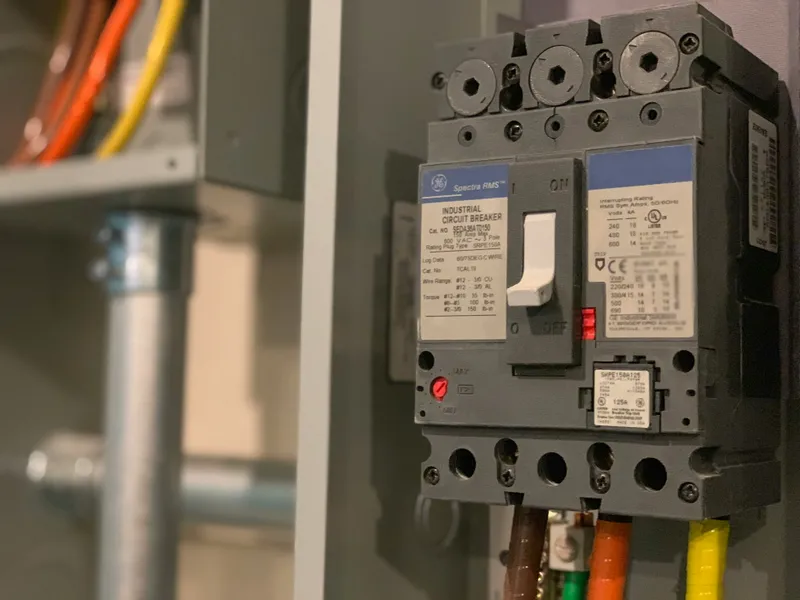
Most facilities don't know their actual available fault current. They assume everything is rated correctly and move on.
The problem is, fault levels don't stay the same. Utility changes, transformer swaps, and system upgrades all impact it. The equipment usually doesn't get updated with it.
That's how systems end up underrated without anyone realizing it. A short circuit study shows you if your system can actually handle a fault.
What a Short Circuit Study Actually Does
A short circuit study calculates the available fault current at each point in your system. That's the maximum current the system can see during a fault.
Every piece of equipment has an interrupting rating. If the available fault current is higher than that rating, the device may not clear the fault safely.
What most people miss is that fault current doesn't stay the same. Utility changes, transformer replacements, or system upgrades can all increase it. We've seen facilities where fault current went up significantly from the original design and nothing else changed with it.
That's how equipment ends up overdutied without anyone realizing it. On paper it looks fine, but it's not rated for what it's actually seeing.
A short circuit study shows you where that's happening so you know if your system is actually rated correctly.
The study calculates fault current at each bus using:
Utility source strength. The utility provides fault current contribution based on their system. This is sometimes modeled as an infinite bus for conservative equipment duty checks, but the actual utility data matters for arc flash.
Transformer impedance (%Z). A lower %Z transformer delivers more fault current. This is one of the most commonly underestimated variables, especially when transformers get replaced.
Conductor length and impedance. Longer runs reduce fault current. This affects both equipment duty and arc flash results at downstream equipment.
X/R ratio. Affects asymmetrical fault current and the mechanical stress on equipment. High X/R ratios increase peak current and can exceed equipment withstand ratings even when RMS values look acceptable. Most studies include this, but it's one of the first things that gets dropped when data is assumed rather than collected.
The study is typically run for two scenarios:
Maximum fault current (utility high) is used for equipment duty checks. This is the worst case for interrupting ratings and bus bracing. If equipment fails here, it fails catastrophically.
Minimum fault current (utility low) governs protective device operation and arc flash. Lower fault current means longer clearing times. Longer clearing times mean higher incident energy. This is the scenario most facilities never think about.
The same system can look fine from an equipment rating standpoint and still produce dangerous arc flash energy under minimum fault conditions. Both numbers matter.
Maximum vs. Minimum Fault: Why Both Matter
Most people think higher fault current is always the worse case. It's not.
Under maximum fault current, breakers see high current and typically clear fast. The equipment duty is high, but clearing time is short.
Under minimum fault current, protective devices may operate slower or drop out of their instantaneous region entirely. Clearing time increases. Incident energy at the arc goes up significantly.
This is especially relevant after utility service changes, transformer replacements, or system reconfigurations. The system that passed a study five years ago may behave differently today.
Fault current is not a fixed number. It varies by configuration, utility conditions, and system changes. Both extremes have to be evaluated.
What We Actually Find in the Field
Most facilities assume they're compliant. Many aren't. They just haven't had a fault yet.
Compliance is only proven under fault conditions. That's the one condition most systems have never actually been tested under.
Breakers with AIC below available fault current. Overdutied equipment is one of the most common findings. The breaker is installed, it operates normally under load, and nobody knows it would fail to clear safely under a fault.
Series ratings that were never validated. Series rating schemes require specific combinations of devices to be listed together. Substitutions happen in the field. The rating no longer applies.
Incorrect transformer impedance assumptions. When a transformer gets replaced, the new unit often has a different %Z. The fault current changes. The study doesn't get updated.
Utility fault current that has increased over time. Utilities upgrade their systems. Available fault current at the service entrance can increase without any notification to the facility.
Fuse substitutions that change let-through characteristics. Swapping fuse types in the field changes both the interrupting rating and the clearing time. That affects arc flash results.
Breaker settings in the field don't match the study. Adjustments get made over time. Setpoints drift. If the model doesn't match what's actually installed, the results aren't valid and neither are the arc flash labels built from them.
Old gear labeled 65kAIC in a system now delivering 80kA. This shows up in older industrial facilities constantly. The equipment is well past its rated duty. One fault event exposes it.
What the Codes Actually Require
NEC doesn't explicitly say "perform a short circuit study." But compliance with two sections effectively requires it.
NEC 110.9 requires that equipment have adequate interrupting rating for the fault current available at its terminals. You can't verify this without knowing the available fault current.
When fault current is higher than a device's rating, it doesn't just trip late. It can fail. Internal arcing, damage, or not clearing the fault at all are all possible.
NEC 110.10 requires that equipment be able to withstand the effects of fault current without extensive damage. This means bus bracing, component ratings, and SCCR all need to be evaluated against actual fault current levels.
IEEE 242 provides industry guidance on system protection and the methodology for fault current analysis.
IEEE 1584-2018 requires accurate fault current inputs to calculate incident energy correctly. If your fault current data is wrong, your arc flash study is wrong. That means wrong PPE requirements, wrong labels, and wrong worker protection.
NEC doesn't require a formal study by name. But you cannot demonstrate compliance with 110.9 and 110.10 without verifying available fault current. That's the practical standard inspectors and engineers work to. And with the 2026 NEC expanding inspector enforcement of arc flash labeling, having accurate fault current data backing your labels is more important than ever.
Inspectors don't need to see a document labeled "short circuit study." They need to see that equipment ratings are verified against available fault current. A study is how that's demonstrated.
What a Real Short Circuit Study Includes
This isn't just running numbers through software.
Utility coordination. Confirm available fault current directly from the utility, including X/R ratio. Assumed values are not acceptable for a defensible study.
Transformer modeling. Document nameplate impedance, grounding configuration, and winding connections. Verify against actual installed equipment.
One-line development or validation. If a one-line doesn't exist or hasn't been updated, the field data has to be collected first.
Equipment duty evaluation. Every protective device and piece of switchgear gets compared against available fault current. Overdutied equipment gets flagged.
Identification of problem areas. Overdutied devices, marginal equipment, and coordination conflicts all get documented with specific recommendations.
Scenario analysis. Normal configuration, alternate feeds, tie breakers open and closed, future expansion conditions. Real systems aren't static.
The deliverable is a report that shows what the system can actually handle, where it falls short, and what needs to change.
The value isn't the software output. It's identifying where the system will fail before it does.
Where Short Circuit Studies Go Wrong
These are the patterns that create problems.
Using assumed utility fault current. The utility data needs to come from the utility. Assuming infinite bus for a study that also feeds arc flash calculations produces unconservative arc flash results. This is one of the fastest ways to produce a study that looks complete but isn't defensible.
Ignoring system changes. Transformer upgrades, added capacity, new service entrance equipment. Any of these can change available fault current. Studies don't update themselves.
Not evaluating alternate configurations. Tie breakers, alternate feeds, and paralleled sources all change fault current levels. A study that only models normal configuration isn't complete.
Treating nameplate AIC as sufficient. A breaker rated 65kAIC doesn't mean the system is fine. It means the breaker was rated for 65kA at the time of manufacture. What matters is available fault current at its terminals today.
Not updating after modifications. A study from five or more years ago is often no longer accurate if the system has changed. Most systems change.
Why This Directly Impacts Arc Flash
An arc flash study is only as good as the fault current behind it. If the short circuit model is wrong, the incident energy is wrong. That means your labels and PPE are wrong. That's where a lot of facilities think they're covered but aren't.
Short Circuit, Coordination, and Arc Flash: How They Connect
These three studies are related. They're not interchangeable.
Short circuit study determines available fault current at each bus. This is the input that everything else depends on.
Coordination study uses fault current data to evaluate how protective devices respond to faults. It confirms that the right device clears the fault in the right sequence and in the right amount of time.
Short circuit results also feed coordination. Faster clearing times mean lower incident energy, which directly reduces arc flash exposure.
Arc flash study uses both fault current data and coordination results to calculate incident energy at each piece of equipment and determine required PPE.
You can't do coordination or arc flash correctly without a valid short circuit model. The short circuit study isn't one option in a list of three. It's the foundation the other two are built on.
A Real Example
We evaluated a system where available fault current at the main switchboard exceeded the breaker's interrupting rating by over 15kA. The equipment had been operating for years without issue. Under normal load conditions, nothing flags. The problem only shows up under a fault.
If a fault had occurred at that switchboard, the breaker could have failed to clear safely. That failure mode isn't a nuisance trip. It's an internal arc event at the breaker itself, with the switchboard energized.
The facility had no idea. The equipment looked fine. The labels said the right things. The study is what found it.
The Bottom Line
If you don't know your available fault current, you don't know if your equipment is rated correctly.
That leads to real problems: equipment that can't interrupt a fault, arc flash studies based on bad data, and labels and PPE that don't reflect the actual risk.
Most facilities aren't missing studies. They're working off old ones.
This is where everything starts. If the fault current is wrong, everything built on top of it is wrong.
Get a Short Circuit Study Scoped to Your Facility
We handle the data collection, the modeling, the equipment duty evaluation, and the PE-stamped report. Contact Zech Engineering to get started.