
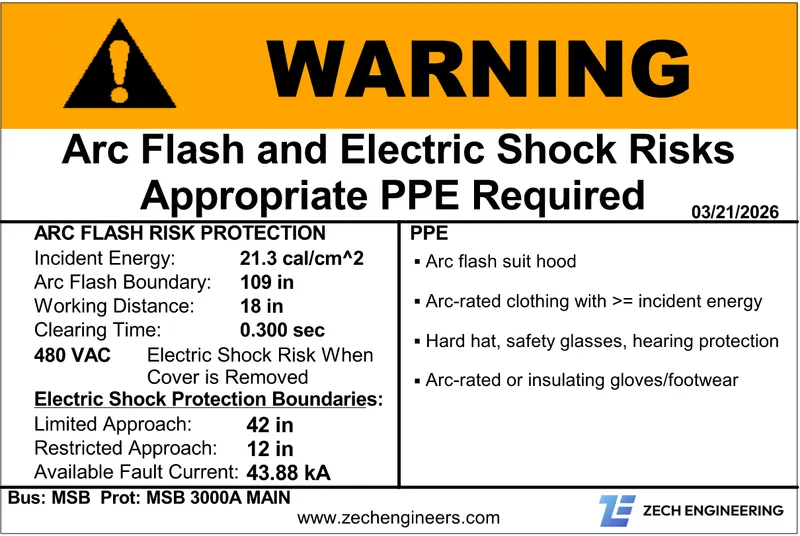
The 2026 National Electrical Code makes the most significant changes to NEC 110.16 in years. The arc flash calculations themselves have not changed. What changed is that the labeling requirements are now written directly into the NEC, which makes them far easier for electrical inspectors to enforce during routine inspections. This article walks through exactly what is different between the 2023 and 2026 editions.
2026 NEC adoption is already underway. Minnesota adopted the 2026 NEC effective August 17, 2026. Permits filed before that date remain under the 2023 NEC. Maine requires the 2026 NEC for installations commencing on or after July 1, 2026, subject to state amendments.
Code adoption varies by jurisdiction. State and local amendments, permit dates, and AHJ interpretations may affect which requirements apply to a specific project. Always verify the governing code with the AHJ.
Last verified: August 2026
Summary: The 2026 NEC removed the 1,000A threshold in Section 110.16 and now requires arc flash labels to include four specific pieces of information: nominal system voltage, arc flash boundary, available incident energy (or minimum PPE level), and the assessment date. The calculations themselves have not changed. The requirements are now written directly into the NEC, making them enforceable during routine electrical inspections.
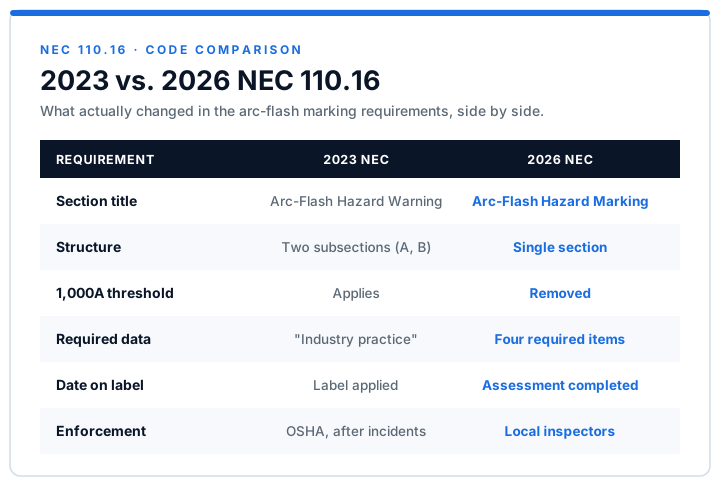
Key takeaway: The 2026 NEC does not change how arc flash calculations are performed. It places detailed labeling requirements directly into the NEC, making them enforceable during routine electrical inspections.
What the 2026 Code Now Requires
In plain English, the 2026 edition requires a permanent arc flash marking on qualifying equipment, and that marking has to carry four pieces of information:
- Nominal system voltage. The operating voltage of the equipment.
- Arc flash boundary. The distance at which incident energy drops to 1.2 cal/cm².
- Available incident energy, or minimum required PPE level. How much thermal energy a worker could be exposed to, or the PPE category that covers it.
- Date the arc flash assessment was completed. Ties directly to NFPA 70E's five-year review cycle and makes study currency visible at inspection.
What does NEC 110.16 require? NEC Section 110.16 requires a permanent arc flash marking on electrical equipment that may require examination, adjustment, servicing, or maintenance while energized. The 2026 NEC specifies four required data points: nominal system voltage, arc flash boundary, available incident energy or minimum PPE level, and the date the assessment was performed.
The Real Story: An Enforcement Shift, Not Just a Technical Update
Most coverage focuses on technical details: the removal of the 1,000-amp threshold, four required data points, and date changes. However, the substantive shift involves enforcement authority.
NFPA 70E has required detailed arc flash labels for years, with information closely mirroring what the 2026 NEC now mandates: voltage, arc flash boundary, incident energy, and PPE level. NFPA 70E also requires working distance, which the NEC does not.
The enforcement difference: NFPA 70E is enforced by OSHA reactively, typically after complaints, reported incidents, or targeted programs. Many facilities go years without OSHA visits, treating NFPA 70E's labeling requirements as best practice rather than hard requirements. Generic warning stickers have been considered acceptable by many facility owners calculating low citation risk.
The NEC becomes law once adopted by states or local jurisdictions. Authorities Having Jurisdiction (AHJs), local electrical inspectors, enforce it proactively and routinely during construction, renovations, tenant improvements, and permit inspections. They sign occupancy permits and can hold up projects for non-compliance.
With the 2026 NEC, detailed arc flash labeling with calculated data is now inspector-enforceable at routine inspections, fundamentally different from waiting for OSHA.
This page covers what changed in the code. For how to comply and what inspectors actually flag in the field, see our companion guide on arc flash label requirements.
Industrial Control Panels and NEC 110.16
Industrial control panels are one of the categories most affected by the removal of the 1,000A threshold. Under the 2023 edition, many machine control enclosures carried only a generic warning sticker. Under the 2026 edition, if the panel is in a non-dwelling occupancy and is likely to require examination, adjustment, servicing, or maintenance while energized, it needs the same four data points as a main switchboard: nominal system voltage, arc flash boundary, available incident energy or minimum PPE level, and the assessment date.
Ampere rating is no longer the threshold that determines whether 110.16 applies. For industrial control panels and other feeder-supplied equipment in non-dwelling occupancies, the key condition is whether the equipment is likely to require examination, adjustment, servicing, or maintenance while energized. In most plants that includes:
- Machine and process control panels opened for troubleshooting or sensor replacement
- Motor control centers that are likely to require examination, adjustment, servicing, or maintenance while energized
- Packaged equipment control enclosures supplied by an OEM
- Skid-mounted process panels wired in the field
Two distinctions worth keeping straight:
An SCCR marking is not an arc-flash marking. NEC 409.110 separately requires an industrial control panel to be marked with its short-circuit current rating. That is an equipment-rating requirement and does not satisfy the arc-flash marking requirements of NEC 110.16.
OEM-supplied panels get missed constantly. Equipment that arrives with the machine usually carries the manufacturer's nameplate and SCCR marking but no facility-specific arc flash label — because incident energy depends on the upstream system the panel connects to. That calculation can only happen after installation.
For what goes on the label itself, see what must appear on an arc flash label. For incident energy calculations and equipment-specific labels, see our arc flash analysis services.
What This Means for Your Facility
If You Already Have a Comprehensive Arc Flash Study
Facilities with full arc flash studies including detailed labels, such as voltage, arc flash boundary, incident energy, PPE requirements, and study date, are ahead. Verify labels show the assessment completion date and confirm studies are within the five-year review window.
If You Only Have Generic Warning Stickers on Smaller Equipment
The 2026 NEC creates significant impact here. Equipment below 1,000A previously needing only generic warnings now requires full detailed labels with calculated values. Arc flash studies must be performed to determine incident energy, arc flash boundary, and PPE requirements. Generic stickers no longer pass inspection once jurisdictions adopt the 2026 code. For budgeting, see how much an arc flash study costs.
Example: A 480V, 400A panelboard installed in 2015 with only generic "Warning: Arc Flash Hazard" stickers requires a full arc flash study and detailed marking, including calculated incident energy, arc flash boundary, PPE requirements, and assessment date, once the 2026 NEC is adopted locally.
If Your Study Is Over Five Years Old
The assessment date requirement puts study age front and center. Under NFPA 70E, five-year reviews were required but often overlooked because enforcement depended on OSHA visits. Now that the date is code-required and visible on labels, inspectors can immediately see study currency. A label from 2019 is an obvious red flag during 2026 inspections. And if the utility has made upstream changes since the study was completed, the labels may not just be old. They may be actively inaccurate. For what triggers an update sooner than five years, see when to update an arc flash study. A stale date is often just the visible symptom of the issues a study review commonly surfaces.
Recommendations
- Audit current labels against the four required data points. Identify equipment with only generic warning stickers. These need full arc flash studies. For a compliance walkthrough of what inspectors look for, see our arc flash label requirements guide.
- Check every label's date. If the last assessment exceeds five years, it's already overdue under NFPA 70E. Schedule updates before inspectors begin looking.
- Scope next studies to cover all equipment, not just gear rated 1,000A and above. This has been best practice under NFPA 70E for years and is now code-required.
- Monitor state NEC adoption schedules. Know when inspectors in your jurisdiction will enforce the 2026 edition to avoid permit inspection surprises.
- Include working distance on labels even though the 2026 NEC doesn't explicitly require it. NFPA 70E does, and incident energy is calculated at defined working distance, and PPE selection depends on it.
Accurate labeling depends on verified fault current data. If that hasn't been evaluated, start with a short circuit study.
The Bottom Line
The 2026 NEC didn't create new arc flash calculations. It made detailed labeling inspector-enforceable.
Facilities with comprehensive, up-to-date arc flash studies are generally well positioned for the 2026 NEC, but they should still verify that labels include the required assessment date and all information now specified in Section 110.16.
Facilities relying on generic warning stickers will need studies performed before their next inspection. And as real-world studies regularly uncover, the label is often just the beginning. Code violations hiding behind the panel are common.
What Equipment Actually Needs Labels
The 2026 edition removes the 1,000A threshold, so size is no longer the filter. The key condition is whether the equipment is in a non-dwelling occupancy and likely to be examined, adjusted, serviced, or maintained while energized. For a practical breakdown of which equipment is typically labeled and how the requirements are applied in the field, see our guide to arc flash label requirements.
What Happens If You Miss This
Once a jurisdiction adopts the 2026 NEC, non-compliant labels become an inspection-stopping issue, not a paperwork one:
- The AHJ can refuse to sign the electrical inspection, which blocks the certificate of occupancy
- Re-inspection fees and scheduling delays push project closeout by days or weeks
- Tenant improvements can fail final inspection, delaying move-in and triggering contract penalties
- New service gear can be rejected before energization if labels are not in place at inspection
- Owners and GCs can charge label-related delays back to the electrical contractor
On most projects the study and label package is a small line item compared to the cost of a delayed CO. Handle it before the inspector shows up.
Frequently Asked Questions
Does the 2026 NEC apply to existing equipment?
The NEC is not retroactive. The 2026 requirements apply to new installations and major modifications completed after the code is adopted locally. Existing equipment is generally not forced into compliance by the code alone, though NFPA 70E and OSHA obligations still apply.
Does every panel now require detailed arc flash labeling?
The 1,000A threshold is gone. Detailed labeling now applies to all qualifying equipment likely to be examined or serviced while energized, regardless of ampere rating. A 200A panelboard requires the same calculated label as a 4,000A switchboard.
What information must appear on the label?
The specific information shown on an arc-flash label depends on the applicable requirement and the results of the facility's electrical-safety analysis. See what must appear on an arc flash label for a detailed breakdown.
When does the 2026 NEC become enforceable?
On local adoption. The NEC is adopted state by state and jurisdiction by jurisdiction, and enforcement begins once your area adopts the 2026 edition. Many jurisdictions are adopting it now, so timing varies by location.
Not Sure Your Labels Meet the 2026 NEC?
If you're unsure whether your existing arc flash labels meet the 2026 NEC requirements, we can review your study and recommend any updates needed. Or start with a quick self-check using our free Arc Flash Study Validity Checker.