
Transformers are one of the more debated gray areas in arc flash labeling.
There is generally far less disagreement around labeling equipment such as switchboards, panelboards, and motor control centers. Questions often start when the discussion reaches transformers, especially dry-type units and whether labeling belongs on the primary side, the secondary side, or both.
Do transformers require arc flash labels? And if they do, where should the label be applied?
The answer depends less on the equipment name and more on how the equipment is evaluated under National Electrical Code 110.16.
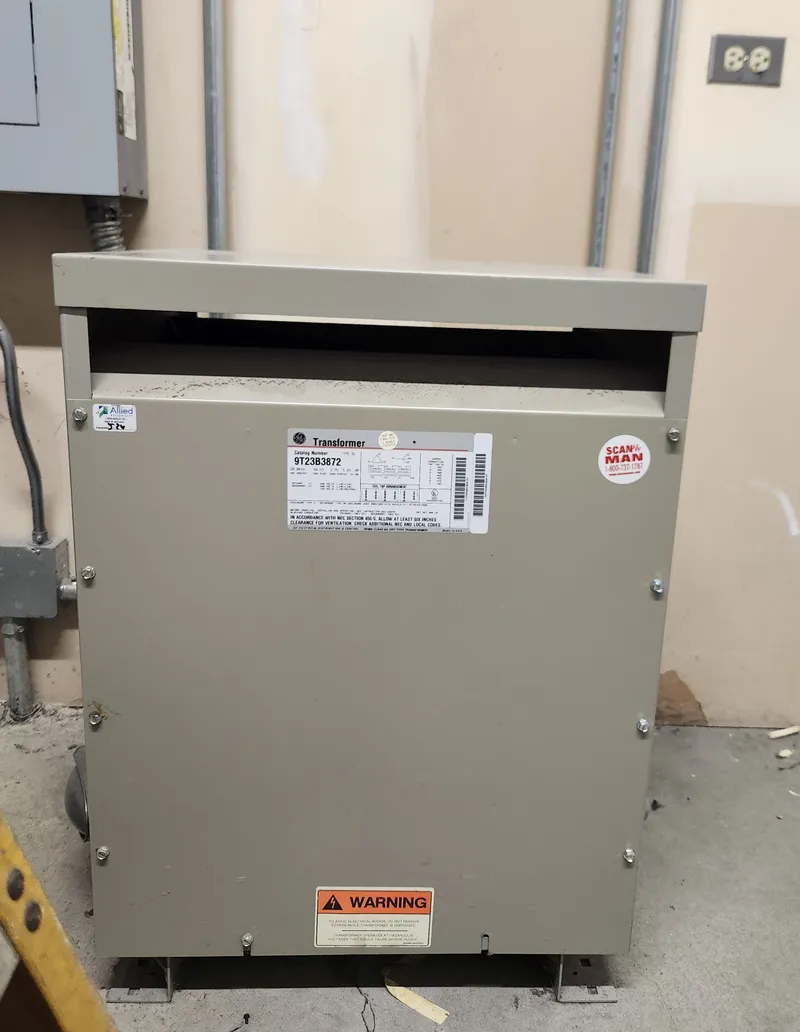
What NEC 110.16 Actually Says
NEC 110.16 does not provide a list of specific equipment types and say label this but not that.
The requirement turns on whether the equipment is likely to require examination, adjustment, servicing, or maintenance while energized.
That is the test.
Not whether the equipment is called a transformer. Not whether it is dry-type or liquid-filled. If energized interaction may occur, the equipment should be evaluated.
That is why blanket statements that transformers never require labels can be misleading.
Can Transformers Require Arc Flash Labels?
Yes, depending on the application.
Transformers should not be assumed automatically exempt.
Situations where transformers may warrant evaluation can include accessible transformer compartments where energized interaction may occur, unit substations, dry-type transformers installed in a way where inspection or servicing may involve exposure, and systems where the transformer itself is part of the location being assessed for arc flash risk.
That does not mean every transformer automatically receives a label. It means the determination should come from the risk assessment and the application.
In Many Cases the Focus Is the Associated Equipment
In practice, the higher-risk interaction point is often not the transformer enclosure itself.
It may be the primary disconnecting means, secondary overcurrent devices, secondary distribution equipment, or switchgear or panelboards fed by the transformer.
Those are often the locations where examination, operation, troubleshooting, or energized interaction is more likely.
This is part of why transformer labeling can be misunderstood. People may really be talking about labeling the associated equipment, not the transformer body itself.
What About Dry-Type Transformers?
Dry-type transformers often generate the most questions.
Some practitioners take the position that they should be evaluated and labeled where they fall within the scope of NEC 110.16. Others focus labeling on the associated primary and secondary equipment instead.
Both approaches usually turn on the same fact-specific question: where is energized interaction reasonably expected to occur?
That matters more than the equipment type alone.
If a Transformer Is Labeled, Should It Be on the Primary or Secondary?
This is where the practical debate usually starts.
There is no universal rule that says it must always be one or the other. The answer depends on the calculated exposure at each location.
Separate Labels for Primary and Secondary
Where incident energy differs materially between the two sides, separate labels may be appropriate. That allows each location to reflect its own calculated hazard. This can make sense where protection, available fault current, or clearing times create significantly different results.
Single Label Using Worst Case Exposure
If only one label is being applied, some practitioners use the worst-case incident energy value. The reasoning is simple. A single label should not understate the hazard. This is often viewed as a conservative approach.
Why Some Default to the Secondary
Some engineers default to the secondary side because interaction is often more likely there, and incident energy can be higher depending on the system. But defaulting by habit alone is not engineering analysis. The calculation should drive the decision. Not convention.
How an Arc Flash Study Handles Transformers
In an arc flash study, the primary and secondary sides of a transformer are modeled as separate bus locations. Each side has different available fault current and different protective device clearing times, which is why incident energy can differ significantly between the two. This is not a code interpretation exercise alone. It requires actual engineering analysis to determine what the exposure is at each location.
A Practical Approach
A defensible approach is often to determine whether the transformer or associated equipment falls within the scope of NEC 110.16, determine where energized interaction is reasonably expected, review incident energy exposure at both primary and secondary locations, ensure any single label does not understate the hazard, and consider whether location-specific labels are appropriate if conditions differ materially.
That keeps the decision grounded in analysis rather than assumptions.
If you are unsure whether your existing arc flash study still accounts for your transformer locations correctly, you can run a quick screening with our Arc Flash Study Validity Checker.
Final Take
Do transformers require arc flash labels? Sometimes yes. But not simply because they are transformers.
The question is whether they fall within the scope of NEC 110.16 based on likely energized interaction.
And if labeling is applied, whether the label belongs on the primary or secondary side should be driven by calculated exposure and application, not habit.
That is where engineering judgment matters.
Need an Arc Flash Study That Properly Evaluates Transformers?
Zech Engineering provides arc flash studies, short-circuit analysis, and protective device coordination with labels meeting 2026 NEC 110.16 requirements. For pricing on a study scoped to your facility, see our arc flash study cost breakdown. To check whether your existing study still reflects your system, use the Arc Flash Study Validity Checker. Or contact us directly for a proposal.