
If you own or operate a facility, arc flash labels are the most visible part of your electrical safety program. They are also the part inspectors look at first, and the part that most often turns up deficient.
This page covers what an arc flash label has to include under NEC 110.16, what equipment requires one, and the mistakes that most often draw an inspection comment. If you want the detailed history of how the code changed between the 2023 and 2026 editions, that is covered separately in our 2026 NEC 110.16 changes guide.
For the latest code changes affecting arc-flash warning labels, see our guide to 2026 NEC 110.16 changes.
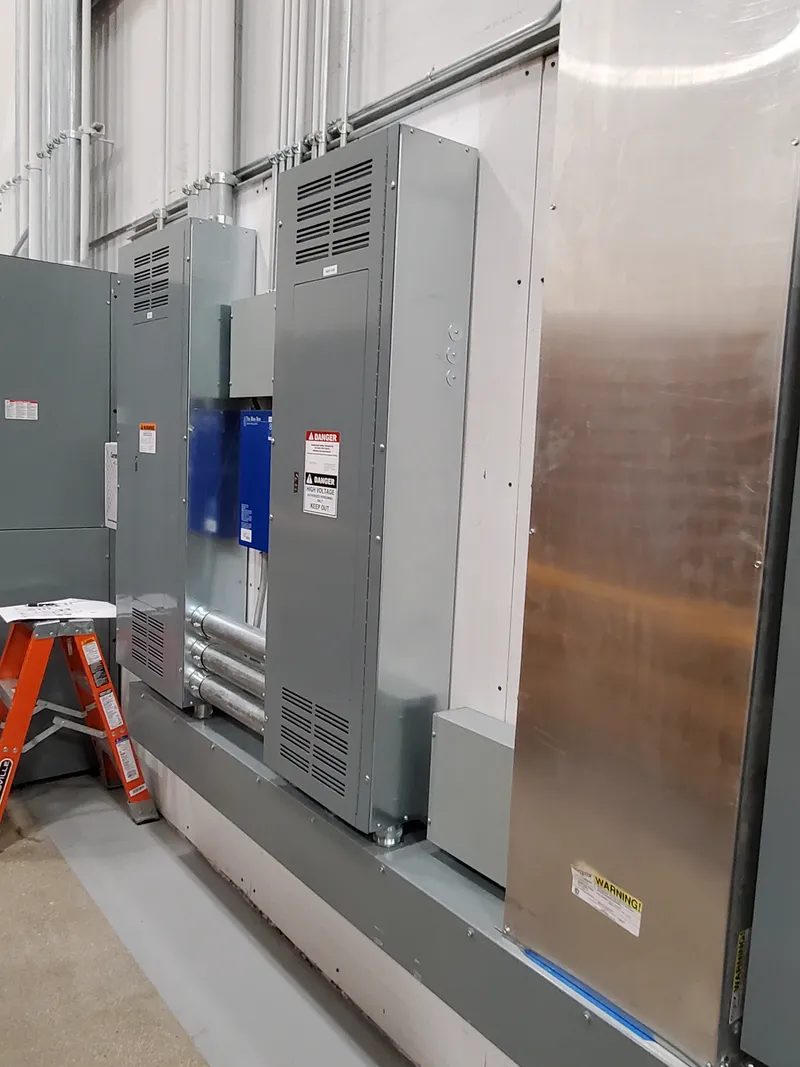
What Must Appear on an Arc Flash Label
In the 2026 edition, NEC 110.16 requires a permanent arc flash marking, field or factory applied, on service equipment and feeder supplied equipment likely to require examination, adjustment, servicing, or maintenance while energized. Per NEC 110.16, that marking must contain the following:
- The nominal system voltage
- The arc flash boundary
- The available incident energy or minimum required level of personal protective equipment
- The date the assessment was completed
| Required on the label | Governing standard |
|---|---|
| Nominal system voltage | NEC 110.16 |
| Arc flash boundary | NEC 110.16 |
| Available incident energy OR minimum required PPE level | NEC 110.16 (values calculated per NFPA 70E) |
| Date the assessment was completed | NEC 110.16 |
| Method used to calculate the above | NFPA 70E 130.5 |
| Review at intervals not exceeding 5 years | NFPA 70E 130.5(G)(1) |
NEC 110.16 also requires that the marking comply with 110.21(B) for durability and be located so it is clearly visible to qualified persons. The section states the marking is to be in accordance with applicable industry practice, and its informational note identifies NFPA 70E, Standard for Electrical Safety in the Workplace, as the source of that practice for developing arc flash labels. In short: the NEC establishes that the label is required and what it must contain, and NFPA 70E provides the methodology for calculating the values that go on it.
One item is worth flagging because it is the source of most confusion. Item 3 is written as an either/or. The label carries the available incident energy, or the minimum required level of PPE, not necessarily both. That distinction has its own section below.
A note on adoption: the NEC is adopted state by state and jurisdiction by jurisdiction, so verify which edition applies in your location. Many jurisdictions are moving to the 2026 edition now.
Incident Energy or PPE Category: Which Does the Code Require?
This is the single most common point of confusion, so it is worth being precise.
NEC 110.16 writes this item as an either/or. The label must show the available incident energy, or the minimum required level of PPE. The NEC requires one of the two on the label. NFPA 70E is where the methods behind those two values are defined, and it is NFPA 70E that draws the line on how they are applied.
In practice, most engineered studies report incident energy in cal/cm2, because that is the value the analysis actually produces and it gives the facility the most information to work with. NFPA 70E treats these as two distinct methods and allows either one, but not both on the same piece of equipment. If an incident energy analysis was performed, the label reports that energy. It is not permitted to run the analysis and then use it to select a PPE category from the table instead. What is never compliant is a label that shows neither.
What Equipment Requires a Label
NEC 110.16 applies to equipment likely to be worked on while energized. That includes:
- Switchboards
- Switchgear
- Enclosed panelboards
- Industrial control panels
- Meter socket enclosures
- Motor control centers
Control panels have their own considerations, covered in do industrial control panels need arc flash labels.
The 2023 edition tied its detailed labeling requirement to service and feeder supplied equipment rated 1,000 amperes or more. The 2026 edition removed that 1,000 ampere threshold. The labeling requirement now applies to the listed equipment likely to require examination while energized, regardless of ampere rating. The ampere threshold no longer limits which equipment falls under the requirement, so smaller equipment that used to be exempt is now in scope.
That single change is why a number of facilities that were compliant under the 2023 code are not compliant under the 2026 code. If your labels were applied under the old threshold rule, smaller equipment that used to be exempt may now be unlabeled.
Common Label Deficiencies I Find During Study Reviews
These are the label problems I run into most often when reviewing an existing facility.
1. Generic warning stickers instead of calculated labels. A red “Warning, Arc Flash Hazard” sticker with no numbers on it is not a compliant label. It warns, but it does not inform. The code requires the specific data above.
2. Missing the assessment date. Common on older labels, because the 2023 code was less explicit about it. The 2026 code requires it, and its absence is now an easy inspection finding.
3. Labels that do not match the current study. Equipment gets relabeled after a revision, but not all of it. You end up with labels from two different studies on the same site, and no way to tell by looking which is current except the date.
4. Smaller equipment left unlabeled. A holdover from the 1,000 ampere threshold. Panels and smaller gear that were exempt under the old rule now require labels.
5. Methods mixed on the same equipment. NFPA 70E allows either the incident energy analysis method or the PPE category table method, but not both on the same piece of equipment. Using the results of an incident energy analysis to then pull a PPE category from the table is specifically not permitted. A label that mixes the two methods is not defensible.
When Does an Existing Label Need to Be Updated?
A label reflects the study behind it, and a study reflects the electrical system on the day it was performed. When the system changes, the label can become wrong without anyone touching it.
NFPA 70E 130.5(G)(1) requires the incident energy analysis to be updated when changes occur in the electrical distribution system that could affect the results, and reviewed for accuracy at intervals not to exceed five years. The assessment date now required on the NEC label is what makes that review cycle visible to anyone reading it, including an inspector. NFPA 70E specifically calls out utility changes such as transformer sizing, along with modifications to protective devices or their settings, as the kinds of changes that trigger an update.
I cover the specific triggers in when an arc flash study should be updated, and the problems I find on existing studies in 10 problems I commonly find reviewing arc flash studies.
What Documentation Should Support the Label
A label is the summary. Behind it should be an engineered study, and behind that study should be the data it was built on. When I review a facility, the documentation I expect to see includes:
- The utility available fault current, with the date it was obtained
- Transformer impedances and ratings
- Protective device types and their actual settings
- Conductor lengths and impedances
- The equipment configuration and one-line diagram as actually installed
- The short circuit and protective device coordination analysis
- The incident energy calculations
- The model file itself, in whatever software was used
If an inspector or an insurer asks how the number on the label was derived, that package is the answer. A label with no study behind it, or a study nobody can produce, is a label you cannot defend. And a study you cannot reproduce is one that has to be rebuilt from scratch the next time the system changes, which is the most expensive way to maintain a study.
Who Is Responsible for the Label?
This comes up constantly, and the answer depends on whether the equipment is new or existing.
On new installations, equipment manufacturers apply a field marking or a placeholder, but the detailed arc flash label depends on a facility specific study, because incident energy depends on the upstream system the equipment is connected to. That study, and the labels that come from it, are typically the responsibility of the facility owner, usually carried out by a consulting engineer. The installing contractor often coordinates getting the labels applied.
On existing installations, the responsibility sits with the facility owner or employer. OSHA and NFPA 70E place the obligation to assess the hazard and inform workers on the employer, and the arc flash study is how that obligation is met.
In practice, the consulting engineer performs the analysis and produces the labels, the contractor or facility staff apply them, and the facility owner is responsible for making sure they exist, stay current, and match the installed system. The engineer responsible for the study is responsible for the technical accuracy of the analysis behind it. Zech Engineering performs the incident energy calculations for your facility and produces the labels that come out of the study.
Frequently Asked Questions
Does every piece of equipment need an arc flash label? Equipment likely to be examined, adjusted, serviced, or maintained while energized needs one. Under the 2026 NEC, the previous 1,000 ampere threshold no longer applies, so smaller equipment that was exempt before now qualifies.
Can I use a PPE category instead of incident energy? Yes, the code accepts either. The label needs the available incident energy with its working distance, or the minimum required level of PPE, but not both. NFPA 70E does not permit mixing the two methods on the same equipment.
Do arc flash labels expire? The label itself does not expire, but the study behind it must be reviewed at intervals not to exceed five years under NFPA 70E, and any time the electrical system changes. The assessment date on the label tells you how current it is.
Who is allowed to perform the analysis behind the label? The incident energy analysis is an engineering calculation. It should be performed under the direction of a qualified engineer, and a PE stamp is often required or expected, particularly where the study supports compliance documentation.
What happens if my labels are not compliant? Where the 2026 NEC has been adopted, arc flash labeling can be checked by local electrical inspectors during routine inspection, not only by OSHA after an incident. Non compliant or missing labels can hold up an inspection sign off. Because adoption varies by jurisdiction, confirm which code edition applies in your location.
Not Sure Where You Stand?
If you are not sure whether your labels meet the current requirements, or whether the study behind them is still valid, we can review your existing study and labels and tell you where you stand. Run our free validity checker or get in touch for a review.