
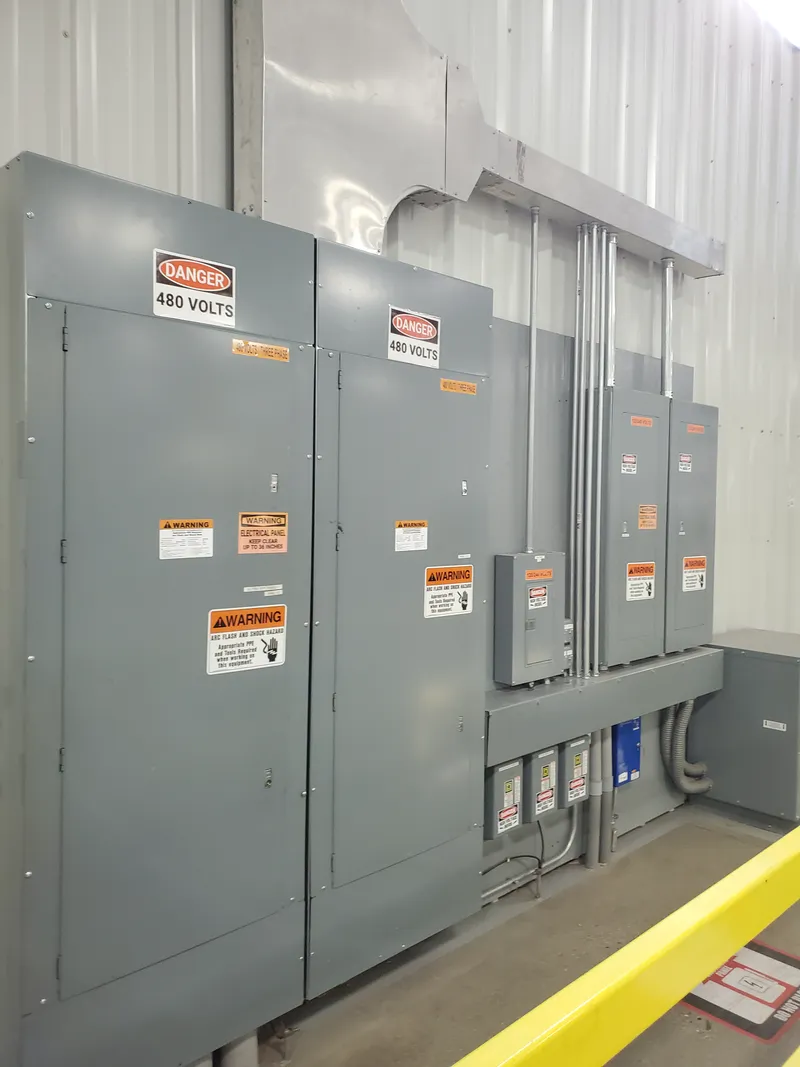
Panelboards are one of the most commonly overlooked gaps in arc flash labeling.
Main switchgear may have labels.
Motor control centers may have labels.
But smaller panelboards are often left unevaluated.
That leads to a common question:
Do panelboards require arc flash labels?
In many cases, yes.
Under NEC 110.16, electrical equipment likely to require examination, adjustment, servicing, or maintenance while energized requires field marking for arc flash hazard information.
Panelboards often fall into that category.
The issue is usually not the size of the panelboard.
It is whether people interact with it while energized.
When Panelboards Typically Require Labels
If a panelboard is likely to be opened, operated, or worked on while energized, it should be evaluated.
That often includes:
- Main distribution panelboards
- Subpanels serving building loads
- Panelboards in mechanical rooms
- Industrial panelboards supporting equipment
- Tenant improvement panels likely to be accessed during operations
A practical filter is simple:
If qualified workers may interact with it energized, it likely needs evaluation.
Why Panelboards Get Missed
This is where people often get it wrong.
Assuming only large gear needs labels
Some assume only switchgear or large service equipment requires labels.
That is not how the requirement works.
Size alone does not determine applicability.
Treating smaller panels as automatically exempt
Small lighting or branch panels are often ignored without analysis.
That assumption can be flawed.
If the equipment may require energized interaction, it still should be assessed.
Using generic warning stickers
A generic warning label is not the same as a calculated arc flash label.
A label developed from an arc flash assessment may include items such as:
- Nominal voltage
- Arc flash boundary
- Incident energy or required PPE
- Assessment date
Does Every Panelboard Need a Label?
Not necessarily.
There may be cases where a panel is only accessed during planned shutdowns and not likely to require energized interaction.
But many facilities apply that assumption too broadly.
A better question is not:
Can I argue this panel does not need a label?
It is:
Will someone interact with this equipment while energized?
That is usually the better filter.
What Inspectors May Look For
This is often where questions about panelboard labeling surface during inspection or project closeout.
As enforcement attention increases, panelboards may become part of what gets reviewed.
Questions that may arise include:
- Was the panelboard evaluated?
- Is there a field label?
- Does the label contain actual calculated information?
- Is the information current?
This is where outdated studies and generic labels often get exposed.
Why the Label Depends on the Study
The label is only as good as the study behind it.
Incident energy depends on factors such as:
- Available fault current
- Protective device clearing time
- Equipment configuration
- Working distance
- System changes over time
A proper arc flash hazard analysis calculates each of these inputs from the actual system rather than relying on assumptions or table values.
That is why study quality and label quality go together.
For a breakdown of how much an arc flash study costs and what drives pricing on that work, see our cost guide.
The Bottom Line
Do panelboards require arc flash labels?
In many cases, yes.
If the panelboard is likely to require examination, adjustment, servicing, or maintenance while energized, it should be evaluated under NEC 110.16.
This is one of the most commonly missed areas in arc flash compliance. The same question comes up with transformers and whether labels belong on the primary or secondary side.
And it often does not get discovered until inspection. See what fails inspection under NEC 110.16 for the specifics.
Need Help Reviewing Which Equipment Requires Labels?
If you are unsure whether your panelboards or other equipment require labeling, that is where we start. We can review your system and identify what needs evaluation before it becomes a delay.