
Most arc flash studies follow a predictable path. Collect field data, build the model, run the calculations, print the labels. If everything checks out, you move on.
But the short circuit analysis behind every arc flash study does something the labels never show. It checks whether the installed equipment is actually rated for the fault current available to it. On a recent study in the field, that analysis turned up three separate NEC violations that had been there since the equipment was installed. None of them were obvious. All of them required digging into manufacturer data and cross-referencing it against actual fault current calculations.
1. Series Combination Ratings That Don't Add Up
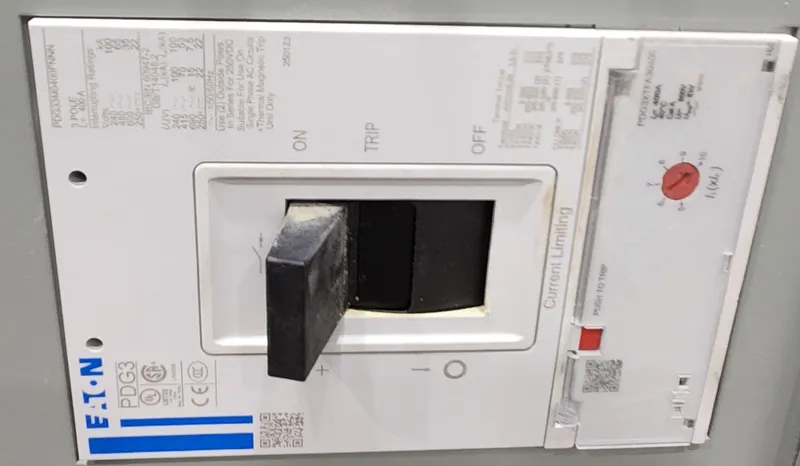
The facility used molded-case feeder breakers ahead of downstream branch panels. The branch breakers in those panels had a low standalone interrupting rating, well below the fault current available to them. On paper that looked fine, because the branch breakers were part of a listed series combination with the upstream feeders.
That is the whole point of a series combination rating. The upstream breaker helps the downstream breaker interrupt faults beyond its standalone capacity. The two devices are tested together, and the combination carries a higher rating than the branch breaker alone.
But here's the catch most people miss: series combination ratings aren't blanket numbers. They vary by the ampere size of the downstream breaker, even within the same breaker family.
When we checked the manufacturer's series rating tables against the breakers actually installed, the available fault current at multiple panels exceeded what the listed combination covered for the larger branch breaker sizes. Every branch breaker above a certain ampere rating at those locations was inadequately rated per NEC 110.9.
The fix is straightforward. Either replace the undersized branch breakers with higher-rated units, or swap the upstream feeders for a current-limiting type that carries a higher series rating across all branch sizes. In this case the second option corrected the problem with far fewer breaker changes.
2. Wrong Voltage Rating on a Breaker
One panel had a molded-case breaker rated for 240V installed in a 480V system. The breaker physically fit the panel. Same frame, same mounting. But its interrupting rating and voltage class were only listed for 240V.
This is a straight NEC 110.9 and 110.3(B) violation. A breaker must be rated for the voltage of the system it's installed in. The 240V breaker needs to be replaced with the 480V-rated version of the same frame.
How does this happen? Usually during a replacement or panel upgrade, someone orders the wrong catalog number. The breaker looks identical, installs the same way, and functions normally under everyday load. It's only a problem when a fault occurs and the breaker has to interrupt current at a voltage it was never tested for.
3. Transfer Switch Breakers Not on the Approved List
The facility had an automatic transfer switch (ATS) whose standalone short-circuit withstand rating was below the fault current available at its location. That meant the ATS relied on a series combination with the upstream breaker for adequate protection.
The problem was that the installed upstream breakers weren't listed on the ATS nameplate. The nameplate referenced only an older breaker line that the installed breakers had replaced.
The installed breakers were the functional replacement for that older line, and they carried the same interrupting ratings. But UL series combination ratings are specific to the exact breaker models tested together. Functionally equivalent doesn't mean UL-tested equivalent.
Until the ATS manufacturer confirms the newer breakers have been added to their UL combination testing, the withstand rating at that location is unverified.
Why This Matters
Three different issues. Three different code sections. One common thread: each surfaced only because we modeled the system and calculated the available fault current at every bus, then cross-referenced manufacturer data against field conditions. That is what a short circuit study is for. It is the equipment-duty check behind every arc flash study, and it is where problems like these get caught.
These are the same kinds of findings I write about in 10 problems I commonly find when reviewing existing arc flash studies. A label-only arc flash vendor wouldn't catch any of them. That is why an arc flash study pays for itself. They'd print labels and move on. The labels might even be correct for incident energy, but the equipment behind them still wouldn't be code-compliant.
Equipment duty doesn't stop at interrupting and withstand ratings either. The same model feeds a protective device coordination study, which sets the devices to clear faults selectively. Run together, a complete power system study confirms both that your gear can survive a fault and that the right device clears it.
And with the 2026 NEC rewriting Section 110.16, inspectors will have even more authority to enforce these requirements.
Is Your Equipment Actually Rated for Your Fault Current?
If your facility hasn't had a proper short circuit and equipment-duty study, or the last arc flash study was just labels, you might have similar problems hiding in your panels.