
Most arc flash studies are not wrong because the engineer made a mistake. They are wrong because the electrical system changed.
That distinction matters. In most cases the study was accurate the day it was delivered. But electrical systems do not stay frozen. Equipment gets replaced. Transformers get upgraded. Settings get changed during a shutdown and nobody writes it down. One-line diagrams drift away from reality a little at a time.
So when I review an existing study, I am usually not looking for bad engineering.
I am looking for everything that changed after the engineer left.
Here is what I find most often. They fall into three groups. The system changed and nobody tracked it. Real equipment problems that nobody caught. And studies that exist on paper but do not function in the field.
If you want a fast read on your own study before going through the list, our arc flash study validity checker screens it against the same triggers I use.
Part 1: The System Changed and Nobody Tracked It
1. The one-line diagram no longer matches the facility
Why I check this first. The study is a model of your system. If the model is wrong, everything downstream of the error is wrong with it. Nothing else on this list matters if the one-line does not describe the plant.
This is worst at process facilities, where equipment changes constantly.
I reviewed a study at one plant that dated back to 2015. When I walked the facility, so much had changed that the drawings described a plant that was not there anymore.
What is worth understanding is how it got that way. Nobody was negligent. The study was done, handed to the EHS manager, and that person eventually moved on. The next person inherited a binder they had not commissioned and did not know the history of. So it sat. It was not until a new EHS manager ran an internal audit that anyone realized nothing matched.
That is the pattern I see most often. The study does not go stale because someone ignored safety. It goes stale because the person who owned it left, and the knowledge left with them. In my experience the trigger for a review is rarely an incident. It is a personnel change followed by an audit.
What to check: pick three or four pieces of equipment and trace them against the one-line. If any do not match, assume the rest do not either. Then ask who currently owns the study, and whether that person was here when it was performed.
2. The utility data is out of date
When I open a study report, the utility letter is one of the first things I look for, and the first thing I check on it is the date.
Available fault current at your service is an input the utility controls, not you. Utilities upgrade transformers, reconductor lines, and reconfigure feeders on their own schedule, and they do not call to tell you. When that happens, the fault current at your service changes and every calculation built on the old number is suspect.
It is one of the easiest inputs to verify and one of the most commonly skipped.
What to check: find the utility fault current value in the study report and the date it was obtained. If it is more than a few years old, request current data from your utility and compare.
3. Equipment was added or replaced and nobody re-ran the numbers
A transformer gets replaced after a failure. A new MCC goes in for a line expansion. A generator gets added. Each change is handled as maintenance or a small project, so nobody thinks of it as an arc flash event. But each one can change fault current, clearing time, or both.
This is the gap between the five year review cycle and reality. The clock is a backstop, not a schedule. I cover the specific triggers in when an arc flash study should be updated.
What to check: list every electrical change since the study date. Transformers, breakers, fuses, added loads, generators, new services. If the list is not empty, the study needs review.
Part 2: Real Equipment Problems Nobody Caught
Everything above is a modeling problem. What follows is hardware installed in your building right now that may not do what you think it does.
4. Protective devices were never coordinated, or the settings drifted
Why I check this. Clearing time drives incident energy. If the settings in the field do not match the settings in the model, the label is wrong even if nothing else changed. But there is a bigger version of this problem, and it usually shows up as an operational complaint rather than a safety one.
I have been called out to facilities where equipment was nuisance tripping and the assumption was that a breaker had been sized wrong. The client was ready to blame the design.
When I looked at it, the contractor had installed the breakers and left them at factory default settings. No coordination study had ever been performed. Nothing was set to work with anything else. Once the settings were adjusted against the other devices in the system, and against motor inrush, the tripping stopped.
The breaker was never the problem. Nobody had coordinated it.
The same thing happens in reverse. Settings get changed during a shutdown to stop a nuisance trip, nobody documents it, and now the model in the study does not match the plant. Either way, clearing time changed, and incident energy changed with it.
What to check: confirm a coordination study was actually performed, not just an arc flash calculation. Then open a few breakers with adjustable trip units and compare the actual settings against the settings table in the study report. Any mismatch is a finding.
5. Devices applied above their interrupting rating
Why I check this. A short circuit study exists to confirm every device can safely interrupt the fault current available at its location. This is the item on the list with the most serious consequence, and it is the one people are most tempted to skip.
Sometimes I find devices that were flagged as overdutied in the original study and never replaced. The report identified the problem, the correction never got funded, and everyone moved on.
Other times the device was adequate when it was installed and is not adequate now, because the available fault current grew after a utility upgrade.
And sometimes it comes down to how a device got replaced. Replacement breakers are occasionally selected during an outage based on what is available rather than what was specified. Unless somebody compares the interrupting rating of the replacement against the available fault current at that location, an unsuitable device can end up installed and nobody knows. I find this in existing facilities and I find it on new construction.
This is not an arc flash labeling problem. A wrong incident energy number gives you the wrong PPE. An underrated device may fail violently the day it is asked to do its job.
What to check: look for an equipment evaluation or interrupting duty table in the study report. Confirm every flagged device was actually corrected. If the report has no such table, the study skipped a required step.
6. HVAC units and control panels with inadequate SCCR
Why I check this. This one gets missed constantly, and it is a different problem than the one above.
An interrupting rating applies to a device. A short circuit current rating, or SCCR, applies to an entire assembly. HVAC units, control panels, and packaged process equipment all carry an SCCR, and it is often low. Many HVAC units ship standard at 5 kA. Getting a higher rating usually means specifying it as a custom order at the time of purchase, and that decision happens long before anyone runs a study.
Contractors do not always know that. So the unit gets set, connected, and energized, and nobody compares its SCCR against the available fault current at that location.
I have found units where the available fault current exceeded the rating of the assembly, with no current limiting device ahead of it. A fused disconnect is often the fix, because it limits the let through current to something the assembly can withstand. But it has to actually be there, and it has to be sized correctly.
The same issue shows up on process line equipment and industrial control panels. Every assembly has an SCCR. It has to be adequate for the fault current available at its terminals.
What to check: find the SCCR on the nameplate of your HVAC units, control panels, and packaged equipment. Compare it to the available fault current at that point in the system. If the study did not evaluate them, they were not evaluated.
7. The model was built on assumptions instead of field data
One of the quickest ways I can judge the quality of an existing study is by looking at where the data came from. Usually within the first hour I can tell whether someone walked the plant or built the model from drawings.
Good studies are built from nameplates, verified conductor lengths, and confirmed settings. Faster studies are built from typical values and reasonable guesses.
Assumed transformer impedance. Estimated cable lengths. Default utility contribution. Each assumption adds error, and the errors do not cancel out. They stack.
What to check: ask whether the study included field data collection. If the report cannot tell you where its input data came from, treat the results with caution.
Part 3: The Study Exists but Does Not Function
8. The maximum PPE level does not match what the facility actually has
Why I check this. A study sets a maximum PPE level, which is the point beyond which energized work is not permitted. That threshold only works if it matches what the facility can actually do.
I have reviewed studies where the maximum was set without anyone asking the plant what PPE they stock or what their electrical safety program allows. The result is labels that authorize work the facility is not equipped to perform. Or thresholds so conservative that equipment they service routinely gets flagged as no energized work, which in practice usually means the label gets ignored.
Before finalizing a study, the engineer should ask what PPE the facility has available and where they need the line drawn. If they do not have a program to reference, you fall back to a standard. But the conversation has to happen.
A study that does not account for how the facility actually operates is technically correct and practically useless.
What to check: compare the maximum PPE level in your study against the gear your electricians actually have on the shelf. Then ask whether your energized work permit process references the study at all.
9. Labels are missing, wrong, or undated
The study produced labels. Then equipment got repainted, doors got replaced, panels got swapped, and part of the system got relabeled after a revision while the rest did not.
One thing I have learned is that label problems are almost never dramatic. You walk a plant and find labels with different dates on them. Some from the current study, some from an older one. Updating part of a system is not the problem. The problem is that a worker reading a label has no way to know it came from a superseded revision.
The date is the only clue, and only if someone thinks to look for it. The 2026 NEC now requires the assessment date on the label, which makes this an inspection finding rather than just a best practice. I cover that change in detail in the 2026 NEC 110.16 requirements.
What to check: walk a sample of your equipment. Every piece likely to be worked on energized should have a legible label that matches your most recent study revision, and it should carry a date.
10. Nobody can find the study, and nobody uses it
The report exists as a PDF somewhere. The model file is gone. The vendor is out of business or will not release the data. And even where the report is available, the PPE program does not reference the labels, the electricians were never trained on what the numbers mean, and the energized work permit process ignores the incident energy values entirely.
A study you cannot reproduce is a study you cannot update. Every future change becomes a full rebuild.
A study nobody uses did not reduce anyone’s risk. It documented it.
What to check: ask for the model file and input data. Then ask an electrician what the label on their MCC means and what PPE it requires. The two answers together tell you whether the study is doing anything.
Finding 11: “Can’t you just build from the old study?”
I get this question on almost every review. The old study cost real money and it feels wasteful to start over. It is a fair question, so here is the honest answer.
Sometimes yes. Mostly no.
If the model file exists, the input data is documented, and the changes since the study are limited, an update can start from the old model. That saves real time and money.
But most of the work in a study is field verification, not calculation. If the one-line is wrong, the settings are unverified, and the utility data is stale, the old study saves almost nothing. Reusing bad inputs just produces confident wrong answers faster.
An existing one-line is a snapshot of what someone believed was installed on the day they drew it. An existing study is another engineer’s model, with their assumptions in it. When I stamp a study, I am taking responsibility for those numbers.
So I use the old documents to know where to look. Then I go look.
The good news is that the numbers are usually smaller than people fear. Here is what actually drives arc flash study cost, and why a study pays for itself against the cost of one incident or one failed inspection.
The Pattern
Read back through these and they are all the same finding.
The 2015 study at the process plant. The breakers left at factory settings. The HVAC unit with a 5 kA rating sitting on a bus with more fault current than that. The label on equipment that is not there anymore. The report nobody can produce.
Every one of them is invisible from a desk.
An arc flash study is not a document that is right forever. It is a snapshot of an electrical system on the day it was verified. The more that system changes, the less confidence you have that the numbers still describe reality.
The facilities that stay current are not the ones with the newest study. They are the ones where somebody owns it, tracks changes against it, and knows when it stopped matching the plant.
That is also why field verification is not an optional extra. It is the part that confirms the study still reflects the electrical system actually in front of you. When I stamp a study, I am taking responsibility for those numbers, not for what someone assumed was installed ten years ago.
That is why I still spend time opening panels, reading nameplates, checking breaker settings, and comparing the one-line against what is actually installed.
Software calculates incident energy. Engineers verify the inputs.
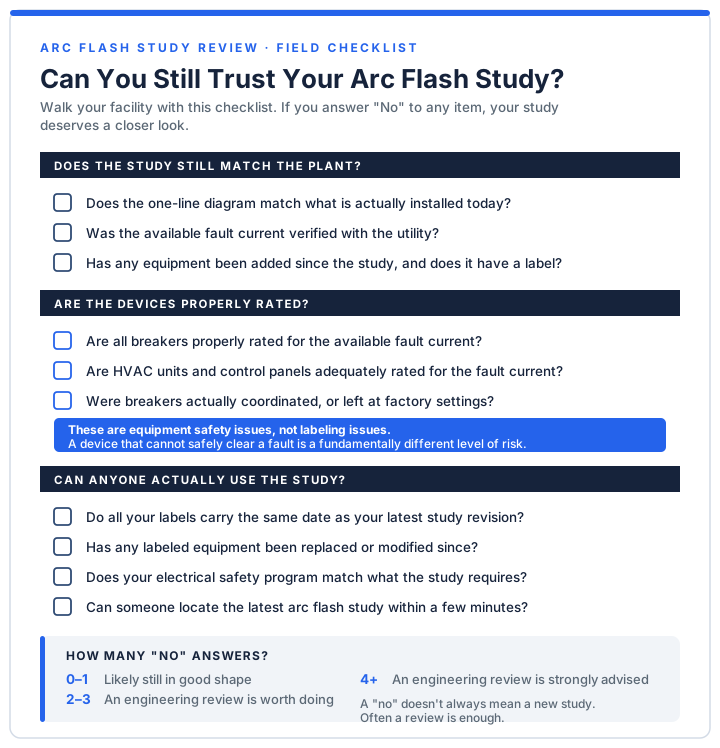
Walk Your Facility
Before you schedule another study, print this checklist and walk your electrical distribution system.
Want a Second Set of Eyes on Your Study?
We review existing arc flash studies and tell you plainly whether they still hold up. If they do, you saved a project. If they do not, you found out before an incident or an inspection did.