
Most facilities assume an arc flash study is something you do every five years and move on. That is not how it works, and you can screen your study against NFPA 70E review triggers to see where yours stands.
A five year review is the minimum. It is not a guarantee your study is still accurate.
We worked with a facility recently where a new EHS manager came in and started digging into their electrical safety program. The last arc flash study on file was from 2015. The facility was a manufacturing operation, and in the years between, equipment had been added, breakers had been changed, and the electrical system looked nothing like what was modeled in the original study.
The labels on the equipment were wrong. The PPE requirements were wrong. Nobody had flagged it because nobody had looked.
That is the risk of treating arc flash as a checkbox.
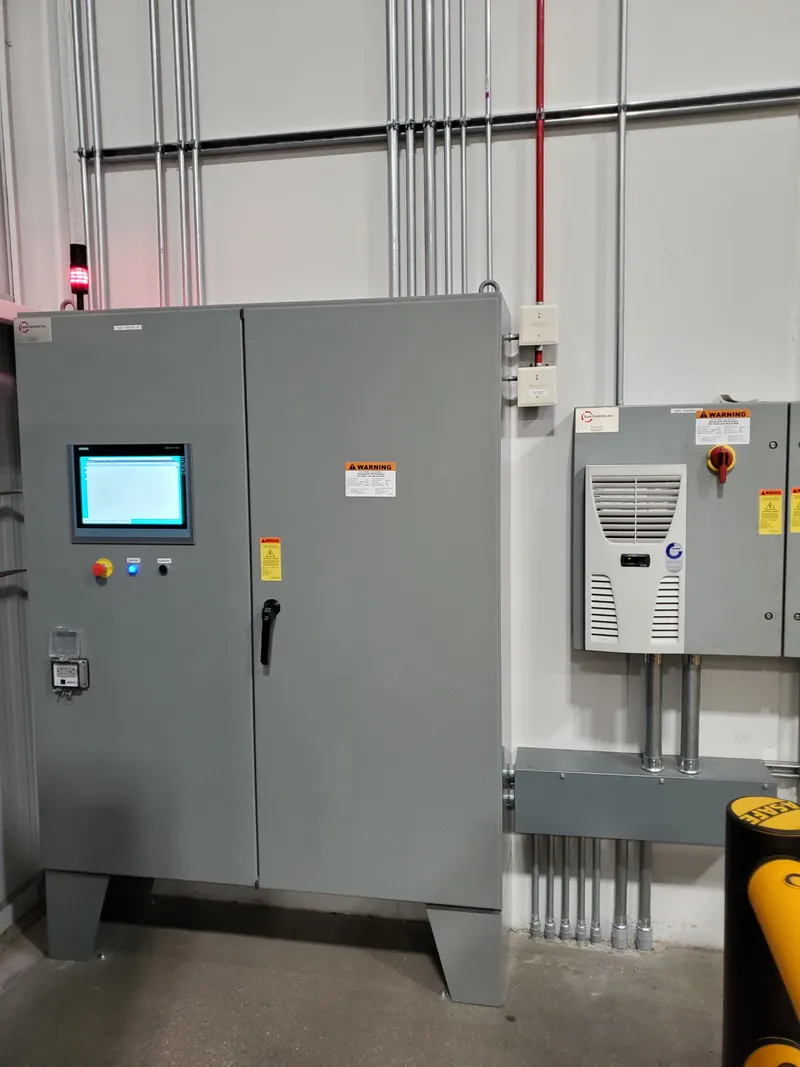
The Five Year Rule
NFPA 70E requires arc flash risk assessments to be reviewed at intervals not exceeding five years. That is the baseline.
But the five year clock is not the only thing that matters. The standard also requires a review any time there is a change to the electrical system that could affect the results.
If your system changes in year two, your study is out of date in year two. The calendar does not reset that.
What Actually Triggers an Update
These are the changes that affect fault current, clearing time, or both. That means they affect incident energy and the numbers on your labels.
Utility service changes. If your utility upgrades their system or changes available fault current at your service, every calculation downstream is affected.
Transformer replacement. A new transformer with different impedance changes fault current throughout the system.
Breaker or fuse changes. Swapping protective devices or changing settings affects clearing time. That drives incident energy.
Protective device setting changes. Adjustments to long-time, short-time, or instantaneous settings can change clearing time and incident energy, even when the breaker itself has not been replaced.
New equipment or added loads. New panels, MCCs, or distribution changes alter the system and can affect coordination.
Generator or alternate source additions. These change fault current contributions and require the system to be re-evaluated.
Any of these can make your labels inaccurate without anyone realizing it.
These are the first things I look for on a review. They account for most of the problems I most commonly find in existing arc flash studies.
What Happens If You Do Not Update
The labels on your equipment reflect the study that was done, not the system that exists today.
If the system has changed, the incident energy values on those labels can be wrong.
A label that says 8 cal/cm² might be understating actual exposure. Workers select PPE based on that number. If the number is wrong, the protection is wrong.
Beyond PPE, an outdated study can mean miscoordinated protective devices, equipment operating outside its interrupting rating, and compliance issues that show up during an OSHA inspection or internal audit. That is exactly what happened in the example above.
How to Tell If Your Study Is Still Valid
Start with a few simple questions.
Has it been more than five years since the last study? If yes, it needs to be reviewed.
Has the electrical system changed since the last study? If you cannot answer that clearly, that is a problem.
Does the one line diagram match what is actually installed? If it does not, the study is unreliable.
Do your labels show an assessment date? The 2026 NEC requires this. If labels are undated or more than five years old, that is a clear flag.
If the answer is yes to any of these, the study needs to be looked at, and in many cases a full arc flash study is the right next step.
If a new study is likely, it helps to know the range up front. You can estimate it with our arc flash study cost estimator or see what drives arc flash study cost.
The Bottom Line
The five year rule exists as a backstop, not a strategy.
If your system has changed, the clock does not matter. The study is out of date when the data is out of date.
The EHS manager in the example above did the right thing. He came in, looked at what was on file, and recognized it did not reflect reality.
Updating that study was not just a compliance step. It was the first step in understanding what his workers were actually exposed to.
That is what a current arc flash study gives you. Accurate data. Everything else, labels, PPE, boundaries, comes from that.
Need to Review Your Study?
If you are not sure your study reflects your current system, that is where we start.