
Most arc flash labels have the information you need. The problem is most people do not know how to read them.
You will see numbers, boundaries, and PPE requirements, but without context it is easy to misinterpret what the label is actually telling you. That is where mistakes happen.
If the label is read wrong, the PPE is wrong. It is that simple.
What Is on an Arc Flash Label
A properly completed arc flash label includes:
- Nominal system voltage
- Arc flash boundary
- Incident energy and working distance, or PPE category
- Assessment date
These are required under NFPA 70E and reinforced by 2026 NEC Section 110.16.
The label is not just a warning. It gives you the data needed to determine how to work on that equipment safely.
The Most Important Number: Incident Energy
If your label includes incident energy, that is the number that matters most.
Incident energy is measured in cal/cm². It represents the thermal energy a worker could be exposed to at a defined working distance.
Your PPE needs to be rated at or above that value.
If the label says 8 cal/cm² and your gear is rated for 4 cal/cm², you are underprotected. There is no margin built in.
Working Distance Matters
Incident energy is tied to a specific working distance, usually 18 in. for low voltage equipment.
If you are closer than that, your exposure goes up. If you are farther away, it goes down.
Most people ignore this and assume the number applies no matter where they are. It does not.
Arc Flash Boundary
The arc flash boundary is the distance where incident energy drops to 1.2 cal/cm², the threshold for a second degree burn.
Anyone inside that boundary needs arc-rated PPE.
Anyone outside it does not, but still needs to respect shock protection boundaries.
PPE Category vs Incident Energy
Some labels show a PPE category instead of incident energy.
That comes from the table method in NFPA 70E.
Category 1 through 4 correspond to increasing levels of protection.
The issue is that the category method only applies within specific fault current and clearing time limits. Outside those limits, it does not apply.
If a system does not meet those parameters, incident energy analysis is required.
Common Mistakes
Reading the label but not understanding it. People see the number but do not connect it to PPE requirements.
Ignoring working distance. The value on the label assumes a specific distance. Getting closer increases exposure.
Using PPE that does not match the label. If the rating is below the incident energy, it is not enough.
Assuming the label is still accurate. Labels are based on system data at the time of the arc flash study. If the system changes, the label can be wrong.
We see this all the time.
Example: What an Arc Flash Label Is Actually Telling You
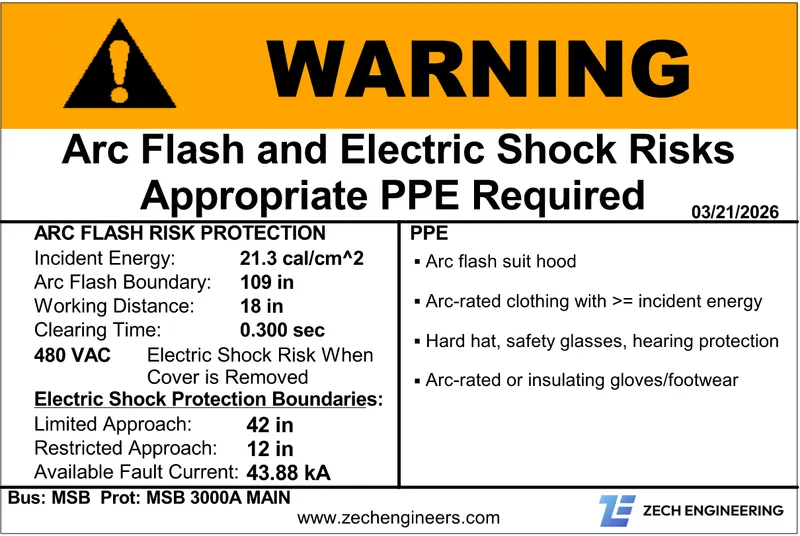
Here is what that looks like on a real label from a 480V main switchboard.
The most important number is the incident energy: 21.3 cal/cm².
That drives your PPE. At that level, a face shield is not enough. You need a full arc flash hood, and all clothing needs to be arc-rated at or above 21.3 cal/cm². There is no margin built in. If your gear is rated below that, you are underprotected.
Now look at what is driving that number. Clearing time is 0.300 sec.
Fault current matters, but clearing time is what really drives exposure. A slower protective device increases incident energy fast. That is where a lot of studies get misunderstood.
Next is working distance: 18 in.
That 21.3 cal/cm² assumes an 18 inch working distance. If you are closer, your exposure is higher than what is on the label.
The arc flash boundary on this label is 109 in., about 9 ft.
Anyone inside that distance needs arc-rated PPE. Anyone outside it does not, but still needs to follow shock protection requirements.
The label also shows available fault current: 43.88 kA. This does not tell you directly what PPE to wear, but it is part of what drives clearing time and incident energy.
Finally, the shock protection boundaries.
- Limited approach: 42 in.
- Restricted approach: 12 in.
This is separate from arc flash. This is shock risk, not thermal exposure. People mix these up all the time.
When the Label Is Wrong
An arc flash label is only as accurate as the data behind it.
Utility upgrades, transformer replacements, breaker changes, or updated settings can all change fault current and clearing time. When that happens, incident energy changes.
That means the label and the PPE requirements can be wrong without anyone realizing it.
The Bottom Line
An arc flash label tells you exactly how to work on a piece of equipment safely.
But only if it is read correctly and still accurate.
If either of those is off, the protection breaks down.
Need Help Reviewing Your Labels?
If you are not sure your labels reflect your current system, that is where we start.