
Most facilities have arc flash labels and still get PPE wrong. Either the label is outdated, incomplete, or nobody actually understands what it means. NFPA 70E is clear on what's required. The problem isn't the standard. It's how it gets applied in the field.
What PPE is required for arc flash? Arc-rated PPE rated at or above the incident energy at the equipment you're working on. That number comes from the label or the study. If your gear is rated below that value, you're underprotected. There's no gray area.
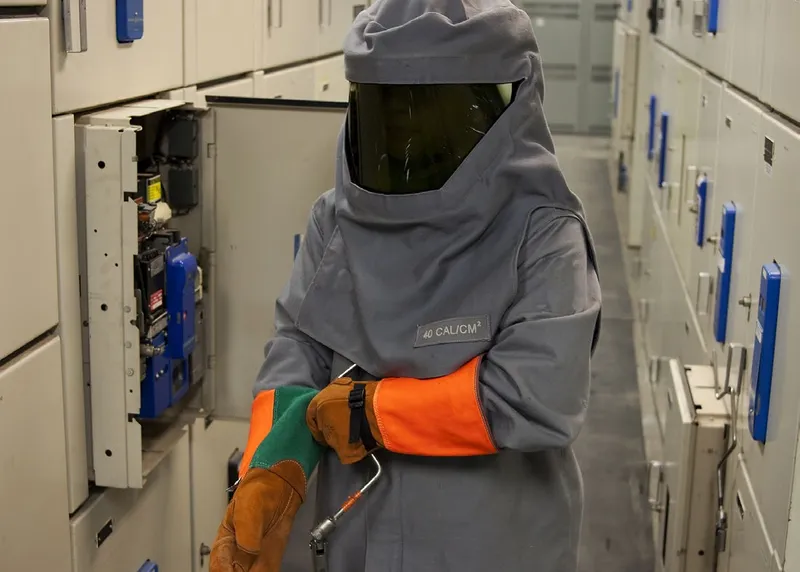
Why PPE Requirements Exist
An arc flash can hit over 35,000°F in a fraction of a second. Regular clothing doesn't hold up. It ignites or melts and makes the injury worse.
Arc-rated PPE is designed to limit heat transfer below the second-degree burn threshold, around 1.2 cal/cm². That's the entire basis of how protection is defined in NFPA 70E and OSHA.
The Two Methods for Determining PPE
NFPA 70E gives you two ways to determine what PPE is required:
1. The Incident Energy Analysis Method (NFPA 70E 130.5(G))
This is the more precise approach and what a PE-stamped arc flash study produces. The study calculates the incident energy at each piece of equipment in cal/cm², a measurement of the thermal energy that could reach a worker at a defined working distance, typically 18 inches for low voltage equipment, unless otherwise specified by the study. If that distance changes, the exposure changes. Your PPE must be rated at or above that incident energy level.
What actually drives incident energy isn't just fault current. It's clearing time. A slow breaker increases exposure fast, even at lower fault current. That's where a lot of studies get misunderstood and where protection coordination matters as much as the study itself.
The required ensemble changes based on exposure level. There are two tiers per Table 130.5(G):
Incident Energy Analysis Method: PPE Requirements (Per NFPA 70E Table 130.5(G))
| Exposure Level | Arc-Rated Clothing | Head/Face | Gloves |
|---|---|---|---|
| 1.2–12 cal/cm² | Arc-rated shirt & pants, coverall, or arc flash suit, rated at or above incident energy | Arc-rated face shield + balaclava OR arc flash suit hood | Heavy leather, arc-rated, or rubber insulating with protectors |
| Above 12 cal/cm² | Arc-rated shirt & pants, coverall, or arc flash suit, rated at or above incident energy | Arc flash suit hood required. Face shield + balaclava is no longer acceptable. | Arc-rated or rubber insulating with protectors |
All exposures require: hard hat, safety glasses or goggles, hearing protection, leather footwear.
The 12 cal/cm² threshold is a key breakpoint in Table 130.5(G) for head and face protection. A face shield with balaclava is acceptable below it, not above it. A facility assuming low exposure and using only a face shield on higher-energy equipment isn't just underprotected, it's out of compliance.
The arc flash boundary is the distance at which incident energy drops to 1.2 cal/cm², the threshold for a second-degree burn. Anyone inside that boundary requires arc-rated PPE. Anyone outside it doesn't need arc-rated gear, but still must stay clear of shock approach boundaries. Arc-rated PPE protects against thermal energy from an arc flash. It does not provide protection from electric shock, which requires voltage-rated gloves and tools.
2. The Arc Flash PPE Category Method (NFPA 70E 130.7(C)(15))
The PPE category method is faster, but it comes with real limitations. It only works if the equipment falls within specific fault current and clearing time ranges defined in NFPA 70E. A lot of facilities use it because it avoids doing a study. That usually means they're either overprotecting or missing the actual hazard.
Note: NFPA 70E requires that only one method be used per piece of equipment. You cannot use both methods on the same equipment, and an incident energy analysis cannot be used to assign a PPE category.
The PPE Categories: AC Systems
Per NFPA 70E Table 130.7(C)(15)(a):
Arc Flash PPE Categories: AC Equipment
| Category | Min Arc Rating | Typical Equipment |
|---|---|---|
| 1 | 4 cal/cm² | ≤240V panelboards |
| 2 | 8 cal/cm² | >240V–600V panels; 600V MCCs (fast clearing, ≤2 cycles); other 600V equipment |
| 4 | 40 cal/cm² | 600V MCCs (slow clearing, 20 cycles); 600V switchgear/switchboards; MV 1kV–15kV |
Note: Category 3 does not appear in the AC equipment table (a), but it exists in Table (c) and applies when using the incident energy analysis method or DC systems. It's not that Category 3 doesn't apply to AC. It just isn't assigned via the table lookup.
The PPE Categories: DC Systems
Per NFPA 70E Table 130.7(C)(15)(b), DC systems (storage batteries, DC switchboards, and other DC supply sources, above 150V–600V) are categorized by available fault current:
Arc Flash PPE Categories: DC Systems
| Category | Min Arc Rating | Fault Current | Arc Flash Boundary |
|---|---|---|---|
| 2 | 8 cal/cm² | Less than 3 kA | Up to 1.2 m (4 ft) |
| 3 | 25 cal/cm² | 3 kA to less than 7 kA | 1.8 m (6 ft) |
| 4 | 40 cal/cm² | 7 kA to less than 10 kA | 2.5 m (8 ft) |
Two important notes on DC: First, the table assumes a 2-second arc duration where no overcurrent protective device exists or fault clearing time is unknown. Battery systems often fall into this situation, which is why DC categories can be higher than expected at relatively modest fault currents. Second, this table only covers systems above 150V DC. Systems below that voltage are not covered by this table and require an incident energy analysis.
PPE Requirements by Category
Once you've identified the category from the AC or DC tables above, Table 130.7(C)(15)(c) tells you exactly what to wear:
PPE Requirements by Arc Flash Category (Per NFPA 70E Table 130.7(C)(15)(c))
| Category | Min Arc Rating | Clothing | Head/Face | Gloves | Footwear |
|---|---|---|---|---|---|
| 1 | 4 cal/cm² | Arc-rated shirt & pants or coverall | Arc-rated face shield or arc flash suit hood | Heavy leather, arc-rated, or rubber insulating with protectors | Leather (AN) |
| 2 | 8 cal/cm² | Arc-rated shirt & pants or coverall | Arc-rated face shield + balaclava OR arc flash suit hood | Heavy leather, arc-rated, or rubber insulating with protectors | Leather required |
| 3 | 25 cal/cm² | Arc-rated shirt, pants, coverall, arc flash suit jacket & pants | Arc flash suit hood required | Arc-rated or rubber insulating with protectors | Leather required |
| 4 | 40 cal/cm² | Arc-rated shirt, pants, coverall, arc flash suit jacket & pants | Arc flash suit hood required | Arc-rated or rubber insulating with protectors | Leather required |
All categories require: hard hat, safety glasses or goggles, hearing protection.
AN: As needed (optional)
How This Works in Practice
We don't just run a study and send a report. We look at what the facility actually has for PPE and line the results up with that.
If they already have gear that covers the exposure, no reason to overshoot. If they don't, we label it correctly so they know exactly what they need to buy. Our arc flash analysis services have your equipment evaluated and field labels produced from the study.
If you are weighing whether to commission a study, you can get a rough budget with our arc flash study cost estimator or read what actually drives arc flash study pricing.
We see this all the time. Facilities have labels and PPE, but the numbers behind them don't match the actual system.
The goal isn't just checking a box. It's making sure the numbers on the label actually reflect the system. Incident energy is tied directly to available fault current and clearing time, which is why a short circuit study is the starting point for getting this right.
The Label Tells You What You Need
A properly completed arc flash label does the work for you. Per NFPA 70E 130.5(H) and 2026 NEC Section 110.16, labels must include:
- Nominal system voltage
- Arc flash boundary
- Available incident energy and working distance, or minimum arc rating of PPE, or arc flash PPE category
If your labels only say "WARNING: ARC FLASH HAZARD" without incident energy values or PPE category information, your workers don't have what they need to select the right PPE. See our NEC 110.16 label requirements guide for what needs to appear on each label.
Common Mistakes
Wearing PPE that doesn't match the label. If the label says 12 cal/cm² and your gear is rated for 8, you're underprotected. This is one of the most common issues we see in the field.
Mixing non-rated and rated gear. A single non-rated piece of clothing in an otherwise compliant ensemble creates a weak point. Everything within the arc flash boundary must be arc-rated.
Using a face shield where a hood is required. Above 12 cal/cm², a face shield with balaclava is not acceptable per Table 130.5(G). An arc flash suit hood is required. This gets missed constantly.
Using PPE categories where they don't apply. The category method has specific fault current and clearing time parameters. Outside those parameters it's not compliant. An incident energy analysis is required.
Relying on old labels. If the system changed and the labels didn't, the PPE selection is wrong. That's where most real risk actually comes from. Not missing PPE, but working off outdated data. Utility upgrades, transformer replacements, or protective device changes can all invalidate existing labels.
Sourcing PPE from unknown online vendors. Testing has shown some gear comes in well below its rated value. If the rating isn't real, the protection isn't either.
What you wear underneath matters. Arc-rated PPE is tested as a system. The rating assumes non-melting underlayers, natural fibers or arc-rated garments. Synthetics underneath can melt under arc exposure and negate the protection of an otherwise compliant suit. See NFPA 70E 130.7(C)(9).
What PPE Is Required at 8 cal/cm²?
An incident energy value of 8 cal/cm² often triggers arc-rated clothing and face protection, but PPE selection should never be based on a generic number alone. It should follow the incident energy shown on the equipment label, the task being performed, and the arc flash risk assessment.
At this level, protection often includes arc-rated clothing with a rating equal to or greater than the incident energy exposure, arc-rated face protection, voltage-rated gloves where shock risk exists, and hearing protection. The key point is that PPE is selected to match the hazard, not pulled from a shortcut chart.
What PPE Is Required at 40 cal/cm²?
Forty cal/cm² is commonly treated as a major hazard threshold, but the correct response is not simply "wear a bigger suit." Higher incident energy values should prompt review of whether the task should be performed energized at all, whether engineering controls can reduce exposure, and whether protective device settings can be improved.
PPE may include higher-rated arc flash suits and additional protection, but the bigger issue is risk reduction, not just heavier PPE.
Arc Flash PPE Category vs Incident Energy Method
These are often confused.
The incident energy method uses calculated exposure at specific equipment to select PPE with an arc rating equal to or greater than the calculated incident energy.
The PPE category method uses task tables in limited cases where specific conditions are met.
Most industrial arc flash studies today use the incident energy method tied to the equipment label. That is what most workers are using in the field.
Common Arc Flash PPE Mistakes
Common mistakes include:
- Selecting PPE from outdated category assumptions instead of the actual equipment label
- Wearing meltable synthetic underlayers that can compromise protection
- Assuming the arc-rated outer layer alone provides full protection
- Relying on outdated arc flash labels based on an old study
- Treating PPE as the first control instead of first reducing hazard through system design or settings
Frequently Asked Questions
What PPE is required for arc flash?
Arc-rated PPE rated at or above the incident energy at the equipment you're working on. That number comes from the label or the study. If your gear is rated below that value, you're underprotected. There's no gray area.
What is the minimum arc flash PPE requirement?
Category 1 is the minimum, which is 4 cal/cm². That usually means arc-rated shirt and pants or a coverall, face shield or hood, gloves, and leather footwear. That said, the real requirement isn't the category. It's the incident energy. If the equipment is higher than 4 cal/cm², Category 1 isn't enough.
What is the difference between arc flash PPE categories?
The categories scale with incident energy. Category 1 starts at 4 cal/cm², Category 2 at 8, Category 3 at 25, and Category 4 at 40. The breakpoint most people miss is 12 cal/cm². Above that, a face shield isn't enough. You need a full hood.
Does NFPA 70E require an arc flash study?
NFPA 70E requires an arc flash risk assessment before energized work. That can be done using the tables or a calculated study. In practice, once you're outside the table limits or you want accurate results, you need a study. Most real systems don't fall cleanly into the tables. Most facilities we see don't fall within the table limits once you look at actual fault current and clearing times.
How often does arc flash PPE need to be replaced?
There's no fixed replacement interval. PPE gets replaced when it's damaged, contaminated, or no longer reliable. What matters is inspection and care. If it's worn out, the rating doesn't mean anything.
The Bottom Line
PPE is the last line of defense.
The study defines the hazard. The label communicates it. The PPE protects against it.
If any one of those is off, the whole system breaks. Most facilities aren't missing PPE. They're working off numbers that don't reflect the system anymore.
Need an Arc Flash Study?
Send over your one-line diagram or a brief system description. We will review it and provide a clear project schedule, fixed fee, and defined scope with no surprises.