
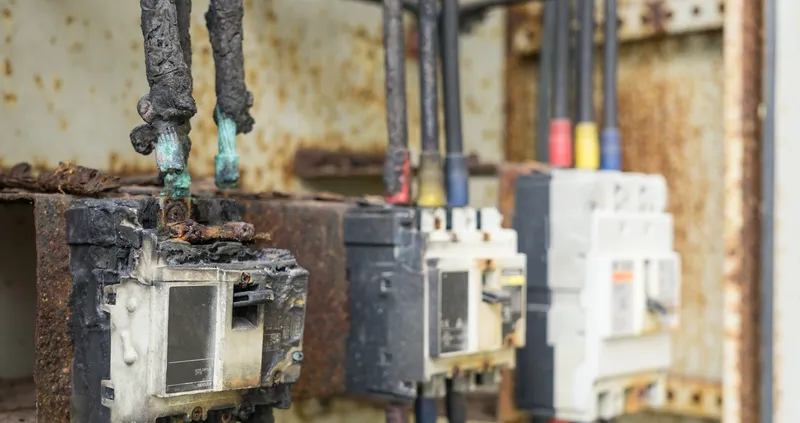
What is arc flash? It is not just a spark. It is a plasma event. Electrical current travels through ionized air between conductors or to ground, sustains itself through that ionized air column, and releases energy in the form of heat, pressure, sound, and light all at once.
Temperatures at the arc can reach 35,000°F. The pressure wave can exceed hundreds of pounds per square foot. Metal vaporizes and becomes conductive. All of this happens in milliseconds.
That's what you're dealing with, and it's why it pays to run a free validity check on your existing study before assuming the labels still match what's actually in the panel.
What Actually Drives the Hazard
The severity of an arc flash event is not random. It's a function of three variables:
Available fault current. The amount of short circuit current available at the point of the arc. Typically expressed in kA. Higher fault current does not always produce higher incident energy. In many systems, lower fault current produces worse arc flash conditions due to slower clearing times.
Clearing time of the upstream protective device. How long it takes the fuse or breaker to interrupt the fault. This is often the most important variable. A device that clears in 0.05 seconds releases far less energy than one that takes 0.5 seconds at the same fault current.
Working distance. The distance between the worker and the arc source. Incident energy falls off with distance. A few extra inches matters more than most people realize.
These three variables feed directly into the IEEE 1584-2018 calculation model. The output is incident energy in cal/cm², the metric used to quantify the thermal hazard at a specific working distance for a specific piece of equipment.
That number is what goes on the arc flash label. That number is what determines PPE requirements.
Fault Current Comes First
Arc flash calculations don't start with arc flash. They start with available fault current.
Fault current defines the arc current. Arc current determines how the breaker or fuse responds. That response defines clearing time. Clearing time drives incident energy.
If your fault current data is wrong, your arc flash results are wrong.
That's why every arc flash study starts with a short circuit study. Not as a formality, but because it directly controls the outcome. Most facilities don't have a hazard problem. They have a modeling problem.
Why Arc Flash Energy Can Get Worse, Not Better
This is the part most people miss, and it's counterintuitive.
Lower fault current can increase incident energy.
If available fault current drops due to a long cable run or a utility change, it can fall below the instantaneous pickup threshold of the upstream breaker. The breaker no longer trips instantly. It operates in the time-delay region and clears in seconds instead of cycles. Longer clearing time means more energy at the arc.
This isn't theoretical. In studies involving utility service changes, it's common to see incident energy jump significantly after an upgrade because the new available fault current no longer triggers the breaker's instantaneous function.
This is why "more fault current is always worse" is an oversimplification. In many systems, the worst-case arc flash condition occurs at reduced fault current, not maximum.
Breaker instantaneous not operating is a worst-case scenario.
If a breaker's instantaneous element is set too high, misadjusted, or has failed, clearing time extends dramatically. This is one of the most common findings in real arc flash studies and one of the reasons you can't rely on a label calculated five years ago.
Maintenance mode reduces energy at that equipment, but not upstream.
Modern relays and some breakers support a high-speed clearing mode for use during maintenance. It reduces incident energy at the equipment being worked on. The line-side terminals of that same equipment remain at full hazard. Workers who understand the panel hazard but not the line-side hazard are still at risk.
It's not uncommon to see 20 to 30 cal/cm² at the load side of equipment under normal conditions and over 100 cal/cm² at the line-side terminals where no upstream device provides protection.
Real Causes in the Field
Generic lists say things like "dust" and "worn insulation." That's true but not useful. Here's what actually triggers arc flash events in industrial and commercial facilities:
Incorrect fuse type. Swapping an RK5 fuse for a Class J changes the let-through current and clearing time. The protection changes. The label becomes wrong.
Overfused equipment. Exceeding the MOCP rating means the protective device may not operate as fast as the equipment requires.
Incorrect breaker trip settings. Instantaneous pickup set too high, long-time delay set too wide. Clearing time extends and incident energy goes up.
Loose terminations. A loose connection creates a high-resistance point that generates heat and can initiate an arcing fault under load. Common in older panels with aluminum conductors.
Equipment SCCR below available fault current. If the Short Circuit Current Rating is lower than what the system can deliver, the equipment can fail catastrophically under a fault rather than protecting the circuit.
Conductive contamination. Dust, carbon buildup, grain particulate, cutting fluid mist. Any conductive material bridging conductors creates an initiation path. This is a leading cause in food processing, grain handling, and machining environments.
What the Codes Actually Require
This isn't optional and it's not a gray area.
NFPA 70E (2024) is the electrical safety standard for the workplace. Section 130.5 requires an arc flash risk assessment before any energized work. That assessment must determine incident energy at each work location or the applicable PPE category. Generic labels that say "Arc Flash Hazard" without calculated data don't meet this requirement.
NEC Section 110.16 requires field marking on equipment that would require examination, adjustment, servicing, or maintenance while energized. The 2026 NEC tightens the specific data required on that label and shifts enforcement from OSHA to the local electrical inspector. That means your next inspection could include label compliance.
IEEE 1584-2018 is the calculation standard. It governs how incident energy is modeled. The 2018 revision significantly updated the equations from the 2002 version. Studies performed before that update may underestimate the hazard at certain bus configurations and gap geometries.
A generic "Arc Flash Warning" sticker is not compliant with current enforcement expectations. It's not a label. It's a placeholder.
What the Numbers Actually Mean
Incident energy is measured in cal/cm². Here's what those numbers mean in practice:
1.2 cal/cm² is the threshold for the onset of a second-degree burn on bare skin. This is not a safe level. It's the point where permanent injury begins.
4 cal/cm² is the minimum for PPE Category 1 under NFPA 70E. Light-duty arc flash environments.
8 cal/cm² is roughly the level where face protection becomes critical. Standard safety glasses are not adequate above this threshold.
25 to 40 cal/cm² is where Category 3 and 4 suits are required. This range is common at medium-voltage equipment and large distribution panels.
Over 100 cal/cm² is a severe blast hazard, not just a thermal one. Overpressure and molten metal become primary concerns. This is frequently found at line-side terminals of main service equipment where no upstream protective device exists.
The difference between 4 cal/cm² and 40 cal/cm² is not just a PPE upgrade. It's a fundamentally different risk profile.
Arc Flash Is a System Problem
Equipment can't be evaluated in isolation. You're not evaluating a panel. You're evaluating everything upstream of that panel. The incident energy at any given piece of equipment is a function of the utility source impedance, the transformer, the main breaker, the feeder breakers, the cable lengths, and how every protective device in that chain is set.
Change any one of those variables and incident energy changes. This is why the following events require a study update:
- Utility service upgrade or change in transformer impedance
- Addition of a generator or alternative source
- Replacement of a main breaker or fuse
- Addition of significant load or extension of distribution
- Any change to breaker settings or coordination
A study from eight years ago is wrong almost every time. Systems change. Labels go stale. When it is time to re-run the numbers, our arc flash analysis services perform the incident energy calculations for your facility.
Effective Risk Reduction
Prevention isn't about posting more signs. It's about engineering the hazard down.
Reduce clearing time. Adjust instantaneous pickup settings to operate as fast as possible while maintaining coordination. Use zone-selective interlocking (ZSI) on main and feeder breakers where available. It allows instantaneous clearing without losing selectivity. Enable maintenance mode on relays when workers are in the equipment.
Increase working distance where practical. Design for remote racking and remote operation of switching equipment. Every additional foot of working distance reduces incident energy.
Use current-limiting devices. Current-limiting fuses reduce both fault current and clearing time. In systems with high available fault current, this can reduce incident energy by an order of magnitude at downstream equipment.
Verify equipment SCCR. Confirm that every piece of equipment is rated for the available fault current at its terminals. This is a code requirement that gets overlooked constantly in older facilities.
Improve coordination. A proper time-current coordination study ensures protective devices operate in the correct sequence, clearing faults as fast as possible at each level while maintaining upstream backup protection.
Validate breaker settings in the field. Modeled settings don't always match what's actually installed. A study built on incorrect settings produces incorrect results. Field verification closes that gap.
Common Arc Flash Mistakes
These are the patterns that show up repeatedly in real studies.
Relying on an outdated study. NFPA 70E recommends reviewing arc flash studies when the electrical system changes and at intervals not exceeding five years. Most facilities miss both triggers.
Assuming higher fault current is always the worst case. Lower fault current can produce higher incident energy if it pushes the protective device out of its instantaneous region. This surprises engineers and facility managers consistently.
Using generic labels with no calculated data. A label that says "Arc Flash Hazard, Wear PPE" tells a worker nothing actionable. They can't select appropriate PPE from that information alone.
Ignoring line-side hazards. The line-side terminals of a main breaker or disconnect have no upstream protection. The hazard level there is essentially the available fault current with no clearing time limit. That requires a different approach entirely.
Not updating labels after system modifications. A new transformer, a replaced breaker, a utility service upgrade. Any of these can change incident energy significantly. Labels that don't reflect current conditions are inaccurate by definition.
Assuming nameplate AIC equals compliance. A breaker rated 65kAIC doesn't mean the system is fine. It means the breaker was designed for up to 65kA. What matters is available fault current at its terminals today. We regularly find equipment where those two numbers no longer match.
The Bottom Line
Arc flash is not rare in industrial systems. It's just poorly understood.
The hazard is driven by system design, not voltage alone. A 480V system can produce a more severe arc flash event than some medium-voltage configurations depending on how the protection is set up.
Without a study, you're guessing on fault current, guessing on clearing time, and guessing on worker exposure. Guessing is not a defensible position when something fails.
A study doesn't just check a box. It tells you where the real hazards are, which ones can be engineered down, and what your workers actually need to wear.
Get an Arc Flash Study Scoped to Your Facility
We handle the field work, the modeling, the labels, and the PE-stamped report. Contact Zech Engineering to get started.