
An arc flash label and an adequate SCCR answer two different safety questions. A control panel may require both, and passing one test does not satisfy the other.
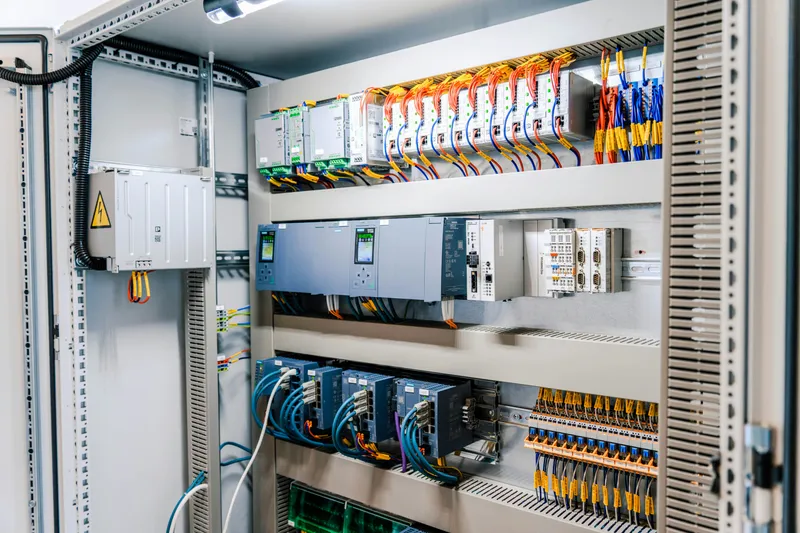
Do industrial control panels need arc flash labels under NEC 2026? In many commercial and industrial installations, the answer is yes. A panel may be smaller than the main switchgear, supplied from another panel, or delivered as part of a machine, but none of those facts automatically place it outside the labeling requirements.
Under the 2026 National Electrical Code, an industrial control panel in a non-dwelling occupancy generally needs a permanent arc flash marking when it is service or feeder supplied and is likely to be examined, adjusted, serviced, or maintained while energized.
But the arc flash label is only half of the review. When an industrial control panel contains power-circuit components and is required to carry an SCCR marking, that rating must be adequate for the available fault current. These are separate safety questions:
- Does the label tell a qualified worker what the arc flash exposure is?
- Can the panel safely withstand the available fault current at its installation point?
A panel can have a complete arc flash label and still have an inadequate SCCR. When that happens, the calculated label does not make the installation compliant or adequately rated for the available fault current.
When Does an Industrial Control Panel Need an Arc Flash Label?
NEC 2026 Section 110.16 applies in occupancies other than dwelling units to service equipment and feeder-supplied equipment likely to require examination, adjustment, servicing, or maintenance while energized. Industrial control panels are specifically included among the equipment examples.
In practical terms, a control panel should be evaluated for labeling when qualified personnel may open or interact with it while energized. Common examples include:
- PLC and automation panels with incoming power circuits
- Machine control panels
- Pump and process control panels
- HVAC and refrigeration control panels
- Robot controller panels
- Panels containing motor starters, drives, transformers, or power distribution components
The fact that a panel is below 1,000 amperes no longer removes it from the detailed marking requirement in the 2026 NEC. The new edition removed the previous 1,000 amp threshold. Panel size is not the deciding factor. Equipment function, supply, occupancy, and the likelihood of energized interaction are.
Local adoption still matters. The NEC becomes enforceable when the state or local jurisdiction adopts that edition, so a facility should confirm which code cycle its authority having jurisdiction currently enforces.
What Must the 2026 NEC Arc Flash Marking Show?
For equipment within its scope, NEC 110.16 requires the permanent marking to include:
- Nominal system voltage
- Arc flash boundary
- Available incident energy or the minimum required level of personal protective equipment
- Date the assessment was completed
The marking must also comply with NEC 110.21(B), be clearly visible to qualified persons, and follow applicable industry practice.
Those values normally come from an arc flash risk assessment. A generic “Warning, Arc Flash Hazard” sticker does not provide the calculated information now listed in the 2026 requirement.
Does Every Control Panel Become Its Own Bus in the Study?
Not necessarily. A physical enclosure and an electrical bus are not always the same thing.
There is no generally recognized industry cutoff based only on enclosure size or ampere rating. “Label the larger control panels” may describe a practical starting point, but size alone is not the engineering test. The decision should be based on energized interaction and whether the panel represents a distinct electrical point that could produce a materially different arc flash result.
The engineer building the power system model must determine whether the control panel represents a distinct electrical point with its own available fault current, protective device clearing time, conductor impedance, or operating condition. If those inputs differ from the upstream equipment, the panel may require its own modeled bus and calculated result.
A control or machine panel will commonly warrant its own modeled bus and label when it has one or more of the following characteristics:
- A three-phase power section
- Its own main disconnect or overcurrent protective device
- Motor starters, variable-frequency drives, transformers, or power distribution components
- Meaningful feeder impedance between it and the upstream bus
- A different voltage, enclosure condition, or working distance
- Routine energized troubleshooting or adjustment
- A separate machine supply or facility feeder
- An SCCR that must be compared with the available fault current at that location
For example, a control panel supplied through a long feeder may have lower available fault current than the switchboard feeding it. At the same time, that lower current can cause the upstream protective device to clear more slowly. The resulting incident energy at the control panel therefore cannot be assumed to match the upstream switchboard.
If multiple enclosures are electrically equivalent and have the same source, conductor impedance, protective device response, working distance, and enclosure characteristics, an engineer may determine that one calculation applies to more than one location. Small control-only enclosures may also be grouped or excluded when the assessment shows that a separate result is not warranted. That should be a documented engineering equivalence decision, not a shortcut based only on equipment size or name.
The Manufacturer’s SCCR Nameplate Is Not an Arc Flash Label
The manufacturer or panel builder and the facility owner provide different information.
For industrial control panels that require an SCCR marking, NEC 409.110(3) requires the marking to be attached to the outside of the enclosure. The rating is established from the rating of a listed and labeled assembly or by using an approved method. An informational note to that section points to ANSI/UL 508A Supplement SB as an example of an approved method.
There is an important exception. NEC 409.110(3) does not require an SCCR marking for an industrial control panel containing only control-circuit components. A control-circuit-only enclosure should not be treated the same as a panel containing power-circuit components.
The facility’s arc flash study does something different. It calculates conditions at the installed location, including available fault current, arcing current, protective device clearing time, incident energy, and arc flash boundary. Those results support the field-applied arc flash label.
The distinction matters:
| Marking | What it tells you | Typically established by |
|---|---|---|
| SCCR nameplate | The assembly short-circuit current rating established through a listed and labeled assembly or an approved method | Panel or machine builder |
| Arc flash label | Expected thermal exposure and protection information for an energized interaction | Facility arc flash assessment |
Neither marking substitutes for the other.
The SCCR Test: Rating Must Meet or Exceed Fault Current
The basic field check is straightforward:
Panel SCCR is greater than or equal to available fault current at the panel
If a panel is marked 5 kA SCCR but the calculated available fault current at its line terminals is 15 kA, the panel is not adequately rated for that installation. Adding an arc flash label with calculated incident energy does not correct the mismatch.
This is one of the most important control panel checks in a short-circuit and arc flash study. NEC 409.22(A) states that an industrial control panel shall not be installed where the available fault current exceeds the SCCR marked in accordance with 409.110(3).
The available fault current must be determined at the panel, not copied from the utility service or assumed from the upstream transformer alone. Transformer impedance, feeder length and size, motors, generators, and system configuration can all affect the result.
The Documentation Requirement Many Facilities Miss
NEC 409.22(B) adds a separate documentation obligation. When an industrial control panel is required to be marked with an SCCR under 409.110(3), the following must be documented:
- Available fault current at the industrial control panel
- Date the available fault current calculation was performed
That information must be made available to people authorized to inspect, install, or maintain the installation. The requirement matters because the SCCR nameplate alone does not prove suitability. Someone must determine the fault current at the actual installation point, retain the result, and compare it with the marked rating.
This documentation is related to, but different from, the date required on the arc flash marking by NEC 110.16. Section 409.22(B) addresses the date of the available fault current calculation. Section 110.16 addresses the date the arc flash assessment was completed.
Why Low SCCR Ratings Create Problems
Panels marked 5 kA are common in the field, but the marked number cannot be assumed to fit every installation. A panel’s assembly rating depends on its construction, component ratings, listed combinations, and the approved method used to establish the rating. The NEC informational note points to ANSI/UL 508A Supplement SB as one example of such a method.
Potential limiting components can include:
- Motor controllers and contactors
- Supplementary protectors used where branch-circuit protection is required
- Power distribution blocks
- Disconnect switches
- Variable-frequency drives
- Components without a suitable marked SCCR or approved combination rating
This is why an otherwise well-built panel can be unsuitable near a large transformer or low-impedance source.
How Can an Inadequate SCCR Be Corrected?
There is no single fix for every panel. Possible paths include:
- Replace low-rated components. Use components or assemblies with adequate marked SCCRs.
- Use a listed or evaluated combination rating. Specific combinations of fuses or circuit breakers, motor controllers, and other components may support a higher SCCR when every applicable condition is satisfied.
- Apply properly selected current-limiting protection. A current-limiting fuse or circuit breaker may be part of an approved solution, but merely adding a device labeled “current limiting” does not automatically raise the panel SCCR. The combination, ratings, conductor sizes, and manufacturer conditions must be evaluated.
- Redesign or replace the panel. For older or undocumented equipment, replacement may be more practical than reconstructing a defensible rating.
- Evaluate another engineered approach. Certain series-rated or field-evaluated solutions may be possible, but they require careful documentation and are not interchangeable with a listed combination.
The correction should be designed or reviewed by a qualified person. A fuse change that reduces incident energy may also affect coordination, process reliability, conductor protection, and equipment listings.
A Practical Control Panel Review
For each industrial control panel, verify the following:
- Is it service or feeder supplied in a non-dwelling occupancy?
- Is energized examination, adjustment, service, or maintenance likely?
- Does the 2026 NEC apply in the local jurisdiction?
- Is the panel represented correctly in the short-circuit and arc flash model?
- Does the panel contain power-circuit components, or does the control-circuit-only exception apply?
- If an SCCR marking is required, is it attached to the outside of the enclosure?
- Is the SCCR at least equal to the calculated available fault current?
- Are the available fault current and calculation date documented as required by 409.22(B)?
- Does the arc flash marking contain all four items required by NEC 110.16?
- Have system changes affected the fault current, clearing time, or incident energy since the assessment?
If the SCCR cannot be found or verified, do not treat the absence as proof that the panel is adequate. Flag it for further evaluation.
Frequently Asked Questions
Does a UL 508A label satisfy the arc flash labeling requirement? No. A UL 508A nameplate identifies construction and rating information, including the panel SCCR. An arc flash label communicates calculated hazard information for the installed electrical system. A qualifying panel may need both.
Does a control-circuit-only panel need an SCCR marking? NEC 409.110(3) provides an exception for industrial control panels containing only control-circuit components. Those panels are not required by that subsection to carry an SCCR marking. That exception does not automatically resolve the separate arc flash marking question under NEC 110.16. The equipment still has to be evaluated against that section’s scope.
Does a control panel need a label if it is fed from a labeled panelboard? It can. The upstream panelboard’s label does not automatically describe the exposure at the control panel. Feeder impedance, protective device performance, and enclosure conditions may produce a different result at the downstream location.
Is a 5 kA SCCR acceptable? Only when the available fault current at the panel does not exceed 5 kA and all other installation conditions are satisfied. The number is not acceptable merely because it appears on the manufacturer’s nameplate.
Can a current-limiting fuse fix a low SCCR? Sometimes, but not automatically. The fuse and downstream component combination must be supported by a listed assembly rating or another approved method, with all applicable conditions satisfied. The engineer must also evaluate the effect on protection and coordination.
Who is responsible for the arc flash label? The panel builder provides the equipment rating information used to establish the SCCR. The installed available fault current and calculation date must be documented and made available as required by NEC 409.22(B). The owner or employer is generally responsible for evaluating the installed system and its workplace hazards. The arc flash assessment and field labeling are commonly completed by the facility’s electrical engineer or study provider.
The Bottom Line
Industrial control panels should not be treated as minor equipment during an arc flash study. Under NEC 2026 Section 110.16, qualifying feeder or service supplied control panels need permanent markings with calculated hazard information. Separately, NEC Article 409 requires applicable panels to carry an SCCR marking, prohibits installation where available fault current exceeds that rating, and requires documentation of the available fault current and calculation date. The informational note to 409.110 points to ANSI/UL 508A Supplement SB as an example of an approved method for establishing SCCR.
The safest review asks both questions. Does the panel have the right arc flash label, and is the panel actually rated for the fault current available at its terminals?
Request an Industrial Control Panel and Arc Flash Study Review
If your facility has control panels with missing SCCR nameplates, generic warning stickers, or ratings below the calculated fault current, Zech Engineering can review the study, identify the gaps, and develop a correction plan.